
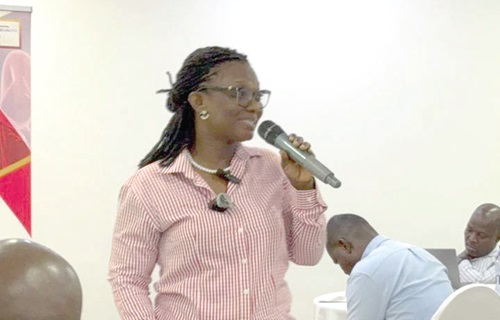
TB can affect any part of body — Dr Rita Amenyo
Tuberculosis (TB) can affect any part of the body.
Therefore, those who experience frequent joint pains, back pain, headache and urinary tract infection have been advised to report to the nearest health facility where they will be screened to receive accurate treatment when it is confirmed.
The Deputy Programme Manager of the National TB Control Programme, Dr Rita Patricia Frimpong Amenyo, who gave the advice at a two-day training programme on Drug-Resistant TB (DR-TB) organised by the Ghana National TB Voice Network (GNTBVN), said TB could affect the brain, spine, the ovaries and fallopian tubes of women.
She explained that usually, the commonest symptoms were cough, fever, weight loss, night sweats and difficulty in breathing.
However, she said, when TB affects the joints, including the knee or spine, one would have symptoms pertaining to those areas.
"So, somebody with TB of the spine will complain mostly of back pain.
That does not mean the cough will not be there. The cough may be there, but what is giving the person the problem at that time would be the back pain.
"Similarly, if TB affects the urinary tract, you will have symptoms of urinary tract infection, which include pain during urination.
You can also have low abdominal pain and frequency in urination. In addition, the TB symptoms will be there - the fever, chest pain and weight loss will be there," she explained.
She said that as clinicians, once somebody reported to their facilities with such complaints, they should probe further to ensure that they arrived at what they thought could be happening to the person.
She said with their available tools, they should screen the person to arrive at the truth and if the test turned out to be TB, they would start treatment immediately.
Dr Amenyo said TB still existed in the country and had not yet been eliminated.
Screen
She, therefore, called on Ghanaians to do medical screening often in order to know their status, while for those who had been diagnosed with the disease, she urged them to endeavour to complete their medications so that they would be completely cured of TB.
"To the general public, TB is curable, treatable and preventable. There is no need to stigmatise anyone with TB.
If you are a landlord and somebody with TB lives in your house, please do not eject them.
The person can be cured of TB and for you, the landlord, we have medicines that can also protect you from getting TB," she advised.
The training, which was for health workers, journalists and survivors of TB, formed part of a nine-month grant on DR-TB by Challenge Facility for Civil Society 2025 being implemented in the Ashanti, Eastern, Greater Accra and Central regions. The four regions were chosen for the implementation of the grant because they have the highest burden of DR-TB case notification in Ghana.
DR-TB is when the TB germ is resistant to the basic TB medications used.
Cases
Touching on TB cases in the country, Dr Amenyo said from January to October last year, 17,000 people were diagnosed with TB, with about 700 from the data being children.
She said more men had TB than women and that it was not about discrimination but the power of women to seek care, demand TB screening, TB testing and go to health facilities to seek treatment.
Dr Amenyo said the figure recorded last year was an indication that Ghana had a long way to go to end TB by 2030, going by the global target, explaining that per the WHO standards, Ghana was expected to find about 44,000 people who have TB every year.
However, the 17,000 figure recorded from January to October 2025 meant that about 25,000 remained undiagnosed.
"Finding TB is not that simple.
A lot of logistics need to go in. For us to get to that target of 44,000, we need a lot of funding support and a lot of health workers who are willing to go the extra mile of screening people for TB in their facilities.
We also need the diagnostic equipment that we have to use to find people with TB.
Again, we need the advocacy of civil society organisations and the support of the media so that anybody with the symptoms of TB will not feel shy, will come to the facility and will get screened," she said.
Stigma
The Technical Lead for HIV, TB and Hepatitis of the WHO Country Office, Dr Kafui Senya, said misinformation and stigma were causing more harm than the germ when it came to fighting the disease.
He expressed the WHO's preparedness to continue to support interventions aimed at eliminating the disease.
Touching on the training, the National Coordinator of GNTBVN, Jerry Amoah-Larbi, said it was intended to build the capacities of people who had lived with the disease for them to be advocates and champions in their communities by finding and identifying people with presumed TB cases, screening them and making sure they are referred to a facility for diagnosis.
On the grant, he said the overall aim was to improve treatment outcomes by addressing services and barriers to TB in the country.
