
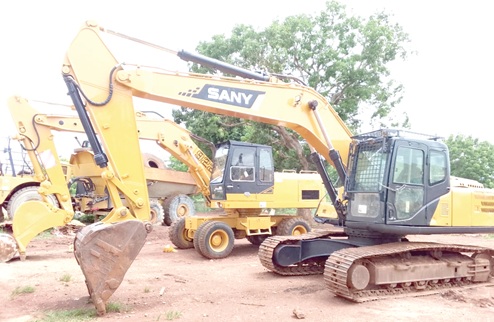
Turning idleness into industry: GIMS ignites hope for unemployed youth with heavy-duty skills training
For many young people, including females in the country’s mining communities such as Afrisipakrom, their day often begins the same way, with uncertainty, frustration and fading hope.
Dreams of stable jobs feel distant, and the temptation to drift into unsafe and illegal activities, such as illegal mining popularly known as "galamsey", looms high.
It is within this difficult reality that a quiet but transformative revolution is taking shape, even as unemployment continues to weigh heavily on the youth in mining communities, turning despair into dignity and idleness into industry.
Rewriting the narrative
At the heart of this change is the Global Institute of Mines and Safety (GIMS), a private training institution at Afrisipakrom in the Tano North Municipality in the Ahafo Region that is steadily rewriting the narrative for thousands of young Ghanaians, particularly in mining communities such as Afrisipakrom.
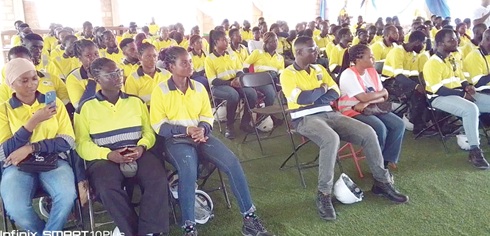
A section of the participants
With the slogan, “Empowered to Perform,” the institute is equipping unemployed youth with practical, on-demand skills in heavy-duty machine operation, opening doors to meaningful livelihoods within the mining and construction sectors.
Over the years, GIMS has focused on training the youth to operate excavators, dump trucks, wheel loaders, backhoes, graders, cesspit emptier trucks, general drilling, bulldozers, forklifts and mobile crane operations to rescue them from joblessness.
The institute has taken thousands of youth from the shackles of unemployment and rekindled the dreams of young people since its inception in 2018.
Orientation
Last Monday, 135 young people from Akyem in the Eastern Region who gained admission to undergo different training in the operation of heavy-duty machines gathered for an orientation programme at the institute.
The beneficiaries walked through the gates of the institute not just as trainees, but as individuals weighed down by the silent burdens of joblessness, family expectations, and futures hanging in the balance.
Sponsored by the Zijin Akyem Development Foundation (ZADeF), the beneficiaries came from six mining host communities to undergo three-month intensive training.
Currently, there are 260 trainees, made up of 216 males and 44 females, at the institute.
Rebuilding broken dreams
Undoubtedly, the institute is doing more than training machine operators. It is restoring confidence, rebuilding broken dreams and giving young people a reason to believe in themselves again.
They represent a new generation poised to transition from uncertainty into opportunity.
For many of them, this is more than just training; it is a lifeline.
Tackle unemployment
The Chief Executive Officer (CEO) of GIMS, Gabriel Larry Yennugu, described the programme as a deliberate intervention to tackle unemployment while promoting responsible mining practices.
“This orientation marks the beginning of a journey that will transform lives,” he said.
“We are not just training machine operators; we are shaping responsible individuals who can contribute meaningfully to their communities and the nation,” he said.
Mr Yennugu explained that GIMS was selected after a rigorous and competitive assessment process conducted by ZADeF, which evaluated several institutions before settling on GIMS for its proven track record, industry experience and comprehensive training approach.
He said the institute had trained more than 3,000 graduates in eight years, explaining that many of them were currently working across mining companies in the country, "We have demonstrated our capacity."
Mr Yennugu explained that their trainees were not just taught how to operate machines, but were equipped with the exact competencies that the industry demands.
Building character, competence
Unlike other training centres that rely on short-term equipment rentals, GIMS boasts its own training facilities, including heavy-duty machinery and hostel accommodation offered at minimal or no cost to trainees.
This enables what Mr Yennugu described as an “extended form of training,” ensuring that graduates leave not only skilled but confident and job-ready.
He said GIMS integrated soft skills such as communication, CV writing, and interview techniques, and explained that employability goes beyond technical know-how.
This holistic model, supported by partnerships with institutions such as the Ghana National Fire Service (GNFS), Ghana National Ambulance Service (GNAS) and the Driver and Vehicle Licensing Authority (DVLA), ensures trainees receive both technical and safety-oriented instruction.
Galamsey
On issues of galamsey, Mr Yennugu made a firm stance against the menace.
“Any trainee who completes this programme and goes into illegal mining is a disgrace to this institution.
We are training them to protect the environment, not destroy it,” he said.
Mr Yennugu expressed concern about the high cost of fuel and equipment maintenance and appealed to the government and stakeholders to support them in procuring modern training simulators, which would enhance efficiency while reducing operational costs.
“Investing in skills training is investing in Ghana’s future.
With the right support, we can scale up and train thousands more across the country," he stated.
Fire safety
The Tano North Municipal Fire Commander, Divisional Officer Grade III Clifford Teiko Ashie, emphasised the critical importance of integrating fire safety into the training, explaining that it would equip the trainees with the skills to respond effectively in the event of fire outbreaks on mining sites.
He explained that the trainees would undergo rigorous and practical fire safety training to enable them to prevent, manage and control fire incidents, particularly in situations where heavy-duty equipment catches fire.
“We’re taking you through all these to make you highly sought-after in the industry,” he said.
Eschew bad behaviours
For his part, the Afrisipahene Kyeame, Nana Kwame Asum, advised the beneficiaries to eschew negative behaviours such as smoking, drug abuse and fighting.
He urged them to exhibit good character and remain focused on their training to avoid disappointment at the end of the programme.
Nana Asum explained that GIMS had played a significant role in providing decent employment opportunities for young people, including females within the community and beyond.
He therefore called on unemployed youth to take advantage of the institute’s programmes to acquire employable skills, secure decent jobs and improve their living conditions.
Turning point
The trainees, who spoke to the Daily Graphic, said the opportunity represented to them was a turning point.
A beneficiary, Paul Adom, said he had been at home for four years after school, "This is my chance to change my life.
I want to become an excavator operator and support my family.”
Another participant, Mavis Ofori, expressed determination to break barriers.
“People think this job is for men, but I want to prove them wrong.
After this training, I want to work with a big mining company and inspire other young women," she said.
Another trainee, Isaac Mensah, said the programme had given him renewed hope after years of struggling to find work.
“Life has not been easy.
You apply for jobs and hear nothing.
Sometimes you feel like giving up.
But being here today, I feel hopeful.
I believe this training will change my story,” he said.
Conclusion
As the sun set on the orientation grounds, one thing was clear: the programme represents more than just training; it is a beacon of hope.
In a country where many young people grapple with limited opportunities, institutions such as GIMS are proving that with the right skills, guidance and determination, the future can indeed be reshaped.
For the 135 trainees who have just begun this journey, the message is simple but powerful: their story is about to change.
Writer's email:
