
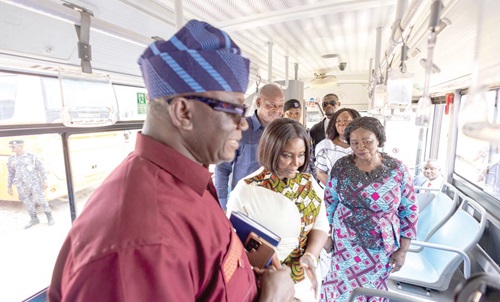
Vice-President advises operators, commuters to preserve state-owned transport assets
The Vice-President, Professor Naana Jane Opoku-Agyemang, has called on transport operators and commuters to protect and properly manage state-owned transport assets.
She emphasised that such resources belonged to the public and must be preserved for collective benefit.
Addressing the management and staff of Metro Mass Transit Limited (MMTL) during a stakeholder engagement last Friday, the Vice-President urged Metro Mass employees to pay close attention to the upkeep of buses under their care.
She added that routine maintenance and responsible use of public assets were essential for prolonging vehicle lifespan and ensuring consistent service.
Prof. Opoku-Agyemang further assured workers that the government remains prepared to reset Metro Mass, including retooling the company and supplying additional buses over time.
“Government is ready to retool Metro Mass and provide more buses. While ten years may seem long, we also know that in this country, vehicles can remain operational far beyond that if they are well maintained. We must all take responsibility for public property because it belongs to every Ghanaian,” she said.
She said that even older vehicles could continue to serve commuters effectively if they were properly maintained.
The Vice-President reaffirmed the government’s commitment to delivering a dependable, efficient, and well-organised public transport system.
Visit
Her visit comes at a time when concerns continue to mount over the shortage of commercial vehicles, a challenge that has led to congestion, long waiting times, and, in some cases, the mistreatment of passengers.
Delivering results
The Vice- President commended the management and staff of MMTL for sustaining operations and delivering results despite severe constraints.
She expressed satisfaction that the company was “generating more with less,” describing the achievement as a source of national hope and proof that public institutions can perform effectively even under pressure.
Prof. Opoku-Agyemang stressed that the ability of Metro Mass to operate with a reduced fleet demonstrates resilience, commitment and ingenuity among workers and management.
She recalled that Metro Mass once operated with about 1,000 buses, but was now functioning with roughly 400, despite a significantly growing population.
She stressed that the current situation was unsustainable, given the increasing demand for public transportation, and urged a renewed collective effort to rebuild the company.
The Vice-President also highlighted the critical role of engineers in restoring and sustaining Metro Mass operations, insisting that the company should be a centre of excellence where bus breakdowns are minimised.
“This should be the place where no bus breaks down. We need to find out what the engineers lack, what the problem is, and how we can support them to do better.”
She said that Ghana had invested heavily in training and education, particularly in technical fields, adding that the country must begin to see tangible returns on that investment — not only at Metro Mass but across the transport sector.
Available
The Managing Director of Metro Mass Transit Limited, Kale Cesar, revealed that out of a total fleet of 478 buses nationwide, only about 130 are currently roadworthy and deployed for daily operations.
He added that 227 buses were completely unserviceable, while others required some form of repairs.
He also said that about 80 buses needed major repairs, while roughly 40 had minor faults that could be fixed with adequate support.
He stressed that the limited number of operational buses severely constrained Metro Mass’s ability to meet public transport demand, particularly during peak hours.
The MD, however, assured the Vice-President that management had pursued pragmatic measures, including engagements with private operators, vendors and investors, to stabilise and revive operations.
He announced that arrangements have been concluded for the supply of additional buses from private suppliers, with deliveries expected to begin from mid-February.
According to him, one company is set to supply about 300 buses, while other vendors will provide Toyota Hiace buses, including 30-seater and 50-seater coastal buses.
He revealed that Metro Mass also has an outstanding contract for electric vehicles (EV buses), but only 10 out of an expected 100 buses have so far been delivered under the contract.
He appealed for urgent government intervention, explaining that if the Ministry of Finance released funds promptly to the sector ministry, the remaining 90 EV buses could be delivered.
He called for broader coordination among transport sector institutions, suggesting that the Ministry of Local Government, which oversees other transport operators, should work closely with the Transport Ministry to redesign Ghana’s transport system for greater efficiency.
