
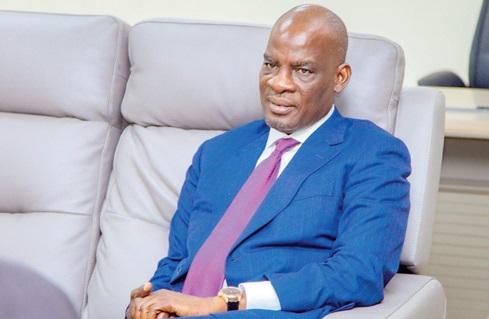
Education Minister proposes committee to annually review university fees
The Minister of Education, Haruna Iddrisu, has proposed the establishment of an annual committee to review university fees as part of efforts to introduce predictability, dialogue and shared responsibility into the determination of tertiary education charges.
He said the proposed committee would provide a structured platform for the government, university authorities and students to engage on fee adjustments, rather than the current situation where fee reviews often generated public tension and political controversy.
“I would like us to discuss whether we cannot have a committee which will annually meet to discuss and review your fees so that we don't have to go through what we are.
Even if we have to go through, we should have a committee at our level so that we can dialogue on some compelling and necessary adjustments,” he said.
Mr Iddrisu made the proposal last Friday when he met with the Vice-Chancellors of public universities under the Vice-Chancellors of Ghana (VCG) in Accra.
Meeting
The meeting, the first of its kind under his tenure, focused on key challenges confronting tertiary institutions, including fees, staffing and utility costs. The remarks were made during the opening session of the meeting, after which the media were excused for a closed-door engagement.
The minister suggested that the committee could be chaired at the deputy ministerial level and include representatives of the tertiary education directorate, university authorities and students, possibly through the National Union of Ghana Students (NUGS) or Students’ Representative Councils (SRCs).
Mr Iddrisu further acknowledged that fee reductions were unlikely in the current economic context but said any upward review should be guided by inflation and justified cost pressures.
He stressed that structured engagement would help balance affordability concerns with the financial sustainability of universities.
Utility costs
Another major issue raised by the minister was the growing burden of utility bills on university campuses.
He described the cost of electricity and water as a “major problem” for both government and tertiary institutions and called for further discussions to develop a roadmap to manage the challenge.
“Then also to look at a roadmap as to how we can continue to bear the cost of utility on the campuses.
That's a major problem for you and for the government; water and electricity, and to discuss that further,” he said.
VCs position
Responding on behalf of the Vice Chancellors, the Chairperson of VCG and Vice Chancellor of the University of Mines and Technology (UMaT), Professor Richard K. Amankwah, expressed support for the proposal to take university fee determination out of Parliament, arguing that the current arrangement often left universities disadvantaged.
He also raised concerns about staffing shortages across public universities, emphasising that institutions had been unable to replace retired staff due to a lack of employment clearance for nearly three years.
He appealed for automatic replacement of retired staff and clearance to employ PhD-trained lecturers currently serving on contract.
“If I use my university as an example, currently we have about 10 people who have completed staff development to get PhDs. And we don't have clearance to employ them.
So they are on contract to teach. Thereby, virtually utilising a big chunk of our internally generated funds,” he lamented.
Prof. Amankwah also assured the minister of VCG’s readiness to support the ministry with data and research to inform sound policy decisions.
