
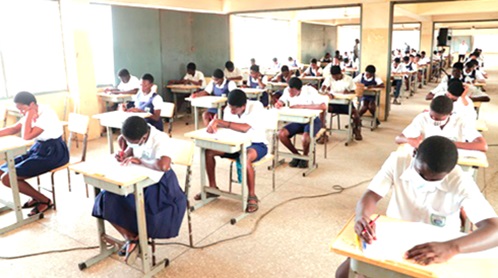
For a nation that defines its future through education, few indicators reveal the health of our learning system as clearly as WASSCE results.
From 2015 to 2024, with early signals from 2025, performance in the four core subjects—English Language, Core Mathematics, Integrated Science and Social Studies—tells a story that is both encouraging and deeply unsettling.
It is a decade of improvement punctuated by instability, revealing a system that has progressed but remains dangerously fragile.
As Ghana prepares for the 2026 examinations, these lessons must not be ignored.
A decade in two halves: Improvement without stability
The period can be understood in two five-year blocks: 2015–2019 and 2020–2024, based on publicly available WAEC pass rates (A1–C6).
Between 2015 and 2019, performance was modest and inconsistent.
Average pass rates stood at 50.66 per cent for English, 40.90 per cent for Mathematics, 45.89 per cent for Integrated Science and 61.54 per cent for Social Studies.
Mathematics and Science, in particular, remained chronically weak, confirming long-standing concerns about STEM education at the senior high level.
The second half of the decade, 2020–2024, recorded marked improvement across all four subjects.
English averaged 62.89 per cent, Mathematics 62.06 per cent, Integrated Science 61.25 per cent and Social Studies 70.03 per cent.
Mathematics saw the most dramatic rise—over 21 percentage points—while English and Science recorded their strongest performances in over a decade.
The 2020–2023 results were widely celebrated.
In 2023, English was passed at over 73 per cent, Social Studies nearly 77 per cent, with Mathematics and Science showing rare stability.
These outcomes challenged early fears that the Free SHS policy would dilute academic standards.
However, the optimism was short-lived.
2024–2025: Clear warning signal
In 2024, performance began to soften. Integrated Science dropped from its 2023 peak of 66.82 per cent to about 58.77 per cent, with Social Studies also declining. Provisional 2025 results were more alarming: Core Mathematics reportedly fell sharply from 66.86 per cent in 2024 to around 48.7 per cent, alongside declines in Integrated Science and Social Studies.
Only English remained relatively stable.
This downturn is not a minor fluctuation. It exposes how poorly institutionalised recent gains were.
While improvements between 2020 and 2023 were real, they were not structurally protected.
That period also coincided with unsustainable practices—over-reliance on past questions, relaxed supervision and heightened examination malpractice.
Without deep reforms in teaching quality, curriculum delivery, assessment integrity and resource equity, performance will continue to swing unpredictably.
Numbers reveal
First, Mathematics and Science remain Ghana’s academic Achilles heel.
Their sharp volatility reflects weaknesses in conceptual understanding, teacher content mastery, pedagogy and resource availability.
The sudden collapse in Mathematics performance in 2025 suggests fragile foundations.
Second, gains have been uneven.
Well-resourced urban and endowed schools benefited disproportionately from the 2020–2023 improvements, while many rural, peri-urban and northern schools lagged. National averages continue to mask deep inequities.
Third, curriculum–assessment alignment remains inconsistent.
Chief examiners repeatedly cite poor application of concepts, weak analytical skills and poor expression.
Teachers often receive syllabi and textbooks late or rely on outdated materials, creating gaps between instruction and assessment.
Fourth, Free SHS expanded enrolment rapidly from 2017, but teacher numbers, infrastructure, laboratories and textbooks did not grow at the same pace.
The recent gains were achieved despite these pressures, largely through short-term, non-data-driven interventions rather than system strengthening.
Finally, public confidence in WAEC and national assessment remains fragile. Each major fluctuation triggers allegations of leakage or inconsistent marking. For a system built on examination credibility, transparency is no longer optional.
National consequences beyond the classroom
Unstable WASSCE performance has serious national implications. Tertiary institutions struggle with unpredictable admission pipelines, especially in STEM programmes.
Ghana’s ambition to build a science- and technology-driven economy is undermined by inconsistent Mathematics and Science outcomes.
Social mobility becomes a lottery for students in poorly resourced schools, while employers increasingly question the reliability of certificates, with long-term consequences for productivity.
Urgent priorities ahead of 2026
Ghana does not need new slogans but disciplined, data-driven action. Six priorities are critical:
1. An independent, transparent review of the 2025 results, including full item analysis to restore public trust.
2. A nationwide Mathematics and Science teacher upskilling programme, institutionalised as continuous professional development.
3. Stronger alignment between curriculum, textbooks and examination standards, supported by timely teacher resource packs.
4. Targeted support for the weakest districts, including specialist teachers and diagnostic interventions.
5. Low-stakes formative assessments nationwide, beginning from SHS Forms One to Three.
6. Open, institutionalised education data systems to support evidence-based reform.
Conclusion
The past decade shows that Ghanaian students can excel when given the right support.
But the sharp downturn in 2025 is a national wake-up call.
A system that improves for a few years and collapses suddenly is not yet strong.
Ghana must urgently protect its gains and fix the foundations.
If the nation is serious about preparing a competitive 21st-century workforce, the stability, quality and integrity of WASSCE—and the system behind it—cannot remain this vulnerable.
The time to act is now.
The writer is an Educational Leadership & Reforms Advocate
Email:
