
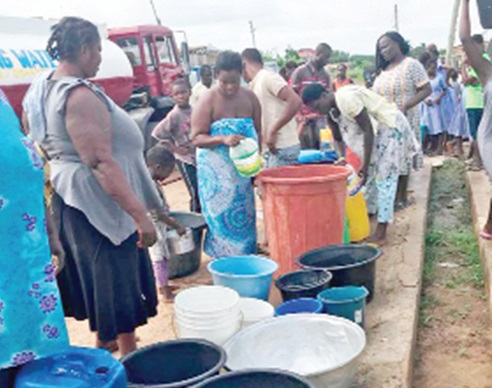
When silence becomes betrayal: Ghana’s water crisis as test of governance
For weeks, the nation was encouraged by public assurances from the leadership of Ghana Water Limited (GWL).
Optimism was carefully cultivated.
Hope was responsibly shared.
Yet today, honesty compels a painful admission: silence has become a form of betrayal
What residents of Tema West, Krowor, Ledzokuku, and the entire Spintex Road enclave are enduring is no longer a temporary inconvenience or a passing disruption.
It is institutional failure, plain and undeniable.
Ghana Water Limited has, repeatedly and visibly, failed to deliver the most basic necessity of life—water. Homes remain dry.
Hospitals are forced into improvisation.
Schools struggle to function with dignity.
Businesses haemorrhage productivity.
Families queue endlessly or pay exploitative prices for what should flow freely.
This is not a seasonal challenge. It is not a technical anomaly.
It is not an act of God. It is the consequence of poor service delivery, weak accountability, and sustained neglect.
Let us be clear without equivocation: this is a national crisis.
When a public utility collapses across large, strategic, and economically vital areas, the matter ceases to be a local complaint. It becomes a governance emergency.
Public confidence in Ghana Water Limited has eroded—not because citizens are impatient, but because they have endured too much for too long.
They have endured without honest communication, without credible timelines, and without any visible sense of urgency.
This erosion is dangerous. Trust, once lost in public institutions, is costly to rebuild.
Water is not a privilege. It is not a favour. It is a right.
Any institution that cannot guarantee this right must either reform decisively or be restructured boldly.
There is no middle ground when human dignity is at stake.
The patience of the people has been stretched thin.
What remains is not anger for its own sake, but a clear and legitimate demand—not for explanations, not for press releases, but for results.
This moment demands immediate, high-level intervention.
Engagement with Finance Minister, Ato Forson must be swift and strategic, leveraging the Desalination Team, just as decisive national action was applied to stabilise the energy debt crisis.
Water security deserves the same urgency, seriousness, and executive attention.
Public relations manoeuvres, internal institutional skirmishes, and blame-shifting only deepen public frustration and quietly erode the hard-won confidence of the JM2 era.
Comforting narratives will not restore water flow.
Optics will not fill taps.
What is required now is action. Ghana Water Limited must urgently revise its Key Performance Indicators (KPIs) to reflect emergency realities.
It must also adopt a transparent emergency response framework and Initiate a strategic mitigation and resilience plan to address the mass and acute water shortage.
Above all, the institution must remember its core mandate: to serve the people, not to exhaust their patience.
This is a defining moment—not only for Ghana Water Limited, but for governance itself.
Institutions exist to solve problems, not to normalise suffering.
The institution must not fail the people.
The writer is the Auther, Resetting Ghana Series and Founder of The Big Reset Desk
Email:
