
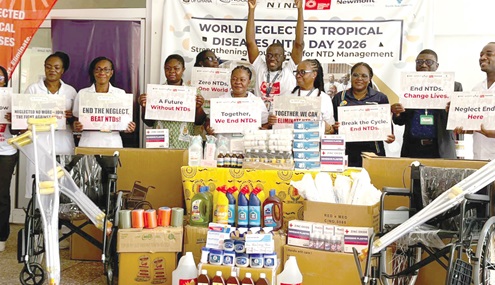
World Neglected Tropical Diseases Day commemorated
The Noguchi Memorial Institute for Medical Research (NMIMR) has underscored the economic importance of eliminating neglected tropical diseases (NTDs).
It cautioned that failure to sustain current gains could undermine productivity and national development as the country enters the final five-year countdown to the World Health Organisation’s 2030 elimination targets.
The Head of Department of Clinical Pathology and leader of the NTD Group at the Department of Parasitology at the institute, Professor Dziedzom de Souza, was speaking at the commemoration of World Neglected Tropical Diseases Day at the Ga West Municipal Hospital, Amasaman, yesterday.
As part of the activities, the NMIMR donated medical supplies to support the management of skin-related NTDs to reduce treatment costs for patients.
The donation was made possible through support from Newmont Ghana and Republic Bank.
National development
Prof. de Souza said healthy communities were fundamental to building strong economies and a resilient nation.
He said NTDs were often referred to as “diseases of the poor”, not because they were minor, but because they disproportionately affected populations with limited access to health care and resources, making recovery difficult and costly.
Prof. de Souza said globally, about 1.62 billion people required interventions for NTDs, with Africa carrying nearly 40 per cent of the global burden.
He said Ghana was endemic to 14 of the 21 NTDs recognised by WHO, including lymphatic filariasis, onchocerciasis, schistosomiasis, soil-transmitted helminth infections, leprosy, yaws and Buruli ulcer.
Impact
Prof. de Souza said NTDs were associated with chronic pains, physical deformities and a loss of self-esteem, forcing many affected persons to withdraw from school, work and active participation in community life.
The combined physical, psychological and social effects, he said, reduced quality of life and limited economic opportunities for individuals and households.
Prof. de Souza added that poor health among farmers led to reduced productivity, lower farm yields, lost income and increased healthcare expenditure.
Progress
Prof. de Souza, however, said that the country had made notable progress in the control and elimination of neglected tropical diseases, having successfully eliminated trachoma as a public health challenge and human African trypanosomiasis.
He explained that efforts to eliminate lymphatic filariasis began in 2000 through sustained mass drug administration and community-based interventions.
As a result, treatment has been stopped in most districts that were previously endemic, with only a few districts remaining under active intervention.
Prof. de Souza further said that similar gains had been achieved in the control of onchocerciasis and several other NTDs, reflecting years of coordinated work by the Ghana Health Service, NMIMR and other partners.
Appreciation
The Administrator of the Ga East Municipal Hospital, Nyaabiire Nsobilla Atindana, expressed gratitude to the NMIM and its partners for the donation, describing it as timely and impactful.
He said the medical supplies would significantly support the hospital’s efforts in managing skin-related neglected tropical diseases and other chronic wound conditions, while helping to reduce the financial burden on patients who often struggled to afford treatment.
Mr Atindana said that the hospital served patients from the municipality and surrounding communities, many of whom reported late due to cost and access challenges, making support for wound care and consumables critical.
