
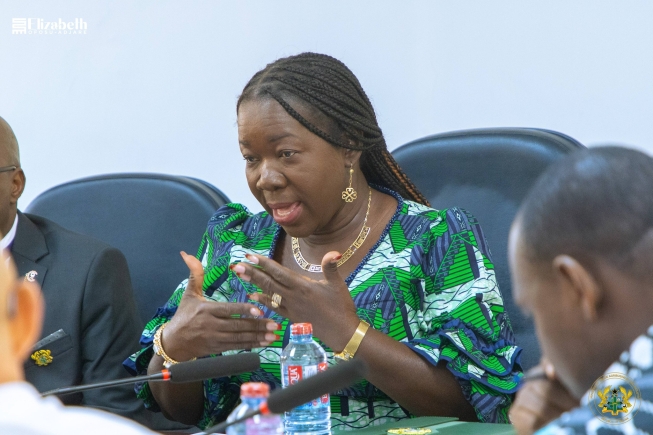
The government plans to establish garment factories, which are expected to employ approximately 27,000 people, as part of efforts to expand local manufacturing and create employment opportunities, the Minister of Trade, Agribusiness and Industry, Mrs Elizabeth Ofosu-Agyare, has said.
Speaking at a press briefing in Accra on Wednesday [January 21, 2026], she said the garment industry offers a fast route into work and remains one of the largest absorbers of labour.
Mrs Ofosu-Agyare said the short training period required before employment makes the sector attractive, especially for young people seeking jobs.
“The garment factory is one industry that employs a lot of people. You do not need to learn for three months or five months before you start work. Within four weeks of training, you already have a job,” she said at the Government Accountability Series press briefing.
She explained that the division of labour within garment factories allows people with different educational backgrounds to participate in the industry.
“Because of the division of labour, the industry accommodates everybody, whether you are a university graduate or someone without formal education,” Mrs Ofosu-Agyare said.
She said the garment factory programme forms part of a wider industrial drive aimed at reducing unemployment and expanding domestic production.
The Ministry also reported growth in non-traditional exports, which reached US$2.54 billion between January and June 2025. This represented a 41.21 per cent increase compared with the same period in 2024.
Mrs Ofosu-Agyare attributed the growth to increased value addition, wider market access and supportive government measures. She said the government is working towards a target of US$10 billion in non-traditional exports by 2030 under the Accelerated Export Development Programme.
She said new policies covering textiles and garments, pharmaceutical manufacturing, special economic zones and automotive component manufacturing have been prepared to attract investors and support industrial activity.
On trade relations with the United States, Mrs Ofosu-Agyare said Ghana secured a three-year extension of the African Growth and Opportunity Act after diplomatic and technical engagements. The agreement had expired in September 2025, leading to tariffs of 10 per cent, later increased to 15 per cent.
“There were political and diplomatic discussions with the US Embassy, followed by technical engagements. My team and I also prepared a technical paper with recommendations for Cabinet,” she said.
Mrs Ofosu-Agyare also credited President John Dramani Mahama’s international standing for helping to open doors during the negotiations.
In terms of investment, she said a memorandum of understanding has been signed with Shenzhen New Jekco of China for an electric vehicle assembly plant. She said land has been acquired and development work is far advanced.
She added that Ghana attracted fresh investor interest after participating in the World Expo in Osaka, Japan, where the country won an award for best theme. Following the event, a 50-member Japanese investment delegation visited Ghana to explore opportunities in automotive components, cocoa, shea and cashew.
Free zones enterprises registered in 2025 generated US$973.43 million in revenue, exceeding figures recorded in 2024. These enterprises created about 1,600 jobs, while total investment into free zones reached 165.29 million dollars.
Mrs Ofosu-Agyare said the Komenda Sugar Factory remains a priority for 2026. She disclosed that an interim management committee has submitted its first report, with a final report expected on Monday.
She said the Ministry is recruiting transactional advisors to assess operations at state-owned enterprises including Akosombo Industrial Company, Volta Star Company Limited, Zuarungu Meat Factory and Pwalugu Tomato Factory to determine options for commercial use.
Seven agro-processing plants at different stages of completion are expected to become operational in 2026. These plants will process yam, fish, poultry, cashew, rice, shea butter and palm kernel oil.
On access to finance, Mrs Ofosu-Agyare said the Ghana EXIM Bank disbursed GH¢304 million in 2025 under strict credit conditions, while pursuing the recovery of legacy loans through the courts.
She said the bank is also exploring ways to raise up to 200 million dollars from the capital market to complete stalled projects and protect public funds.
The Minister said the government has restricted the export of non-ferrous scrap to make raw materials available for local manufacturers, as many factories currently operate at about 30 per cent of installed capacity.
Mrs Ofosu-Agyare said factories continue to face raw material shortages even when financing and markets are available. She said the Feed the Industry Programme is addressing this by securing land banks for raw material production.
She added that all uniforms for state institutions will be sourced locally this year to support local factories, reduce pressure on foreign exchange and create jobs.
She said the Ghana Prison Service and other agencies have already adopted the made-in-Ghana approach.
