

A document circulating online, said to be the result of a search at the High Court (Probate and Administration Division), suggests that the late Ghanaian highlife icon, Charles Kwadwo Fosu (popularly known as Daddy Lumba), did not deposit a will.
If that document is authentic and accurately reflects the court’s records, the legal position it points to is intestacy, meaning the deceased is treated, for legal purposes, as having died without a will filed with the court.
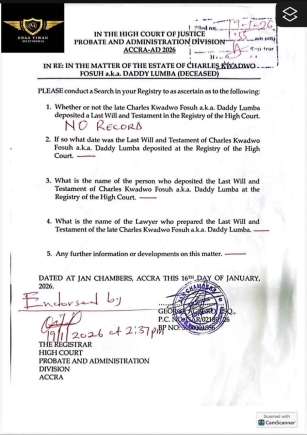
That development should not be a cause for celebration by any side. In practice, the absence of a will does not create a vacuum. Ghana’s legal framework is clear on how an estate must be managed and ultimately distributed. The principal statute that applies to distribution where a person dies intestate is the Intestate Succession Law, 1985 (PNDCL 111).
Competing claims-Akosua Serwaa’s Application, Odo Broni’s Caveat
It has been reported in recent weeks that one of the deceased’s alleged widows, Madam Akosua Serwaa Fosu, has applied to be appointed as an administrator of the estate. It has also been reported that Madam Priscilla, popularly known as “Odo Broni,” has taken steps through her lawyers to oppose that move, including the filing of a caveat.
That is a matter for the court to determine based on evidence and applicable law. The court’s determination is not only relevant to distribution; it also affects who is entitled to priority in applying for Letters of Administration.
Caveat
A caveat is a formal notice filed by a person who claims an interest in the estate and wants to ensure that no grant of probate or Letters of Administration is issued without notice to them.
Under Order 66 rule 11 of the High Court (Civil Procedure) Rules, 2004 (C.I. 47), a caveat may be filed either before or after an application is made, but it must be filed before the grant is issued. Once a caveat is in place, the practical effect is that the registry should not proceed to issue the grant until the caveator is heard and the dispute is resolved.
Probate, administration, and the court process
Order 66 of the High Court (Civil Procedure) Rules, 2004 (C.I. 47) governs probate administration in Ghana by setting out the procedural roadmap for administering estates, whether the deceased died testate (with a will) or intestate (without a will).
Substantively, estate administration is governed primarily by the Administration of Estates Act, 1961 (Act 63), as amended by the Administration of Estates (Amendment) Law, 1985 (PNDCL 113). Under section 1(1) of Act 63, both movable and immovable property of a deceased person devolves on the deceased’s personal representatives from the time of death.
The operational point is simple: no one has lawful authority to deal with the estate unless the court grants that authority.
-
If there is a will, the executor must obtain a Grant of Probate.
-
If there is no will, the appropriate persons must apply for Letters of Administration.
Until probate or Letters of Administration is granted, the estate cannot be lawfully distributed.
Applying for Letters of Administration
An application for Letters of Administration is typically made ex parte, supported by an affidavit. The court may grant Letters of Administration to a maximum of four (4) persons, and the law recognises an order of priority, commonly applied as follows:
-
Surviving spouse
-
Surviving children
-
Surviving parent
-
Customary successor
The Constitution and PNDCL 111
Even as procedural battles play out, the distribution framework remains anchored in law.
First, Article 22(1) of the 1992 Constitution provides that a spouse shall not be deprived of a reasonable provision out of the estate of a spouse, whether or not the deceased made a will.
Second, Article 28 (b) states that every child, whether or not born in wedlock, shall be entitled to reasonable provision out of the estate of its parents.
The PNDCL 111 sets out the specific entitlements where a person dies intestate.
Household chattels
Under section 3 of PNDCL 111, where the intestate is survived by a spouse, a child, or both, the spouse and/or child(ren) are entitled absolutely to the household chattels.
Residue of the estate
Under section 5(1) of PNDCL 111, where the intestate is survived by a spouse and a child, the residue of the estate devolves as follows:
-
3/16 to the surviving spouse
-
9/16 to the surviving child(ren)
-
1/8 to the surviving parent(s)
-
1/8 in accordance with customary law
What this means
If, at the end of the main widowhood battle, the court maintains that there are two surviving spouses of Daddy Lumba, then:
-
The spouse(s) and the children will be entitled to the household chattels under section 3.
-
For the residue of the estate, the spouse(s) will be entitled to 3/16 to share among themselves (where there is more than one spouse recognised by law).
-
The children, regardless of the status of their mothers or public commentary, are entitled to 9/16 to share among themselves.
