
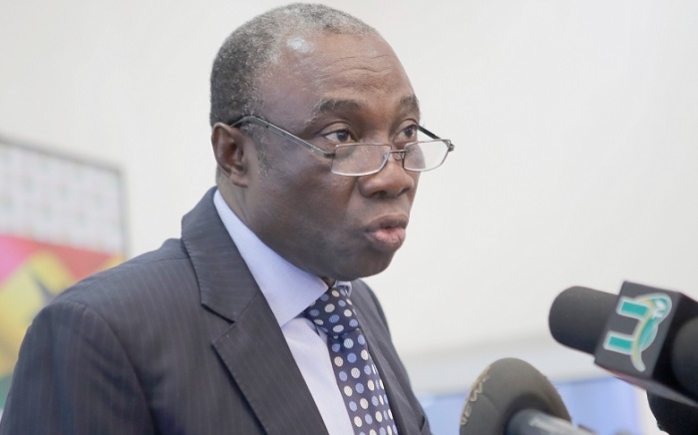
Apply fuel discounts nationwide or stop them, former Power minister tells NPA
Former Minister of Power, Dr Kwabena Donkor, has called on the National Petroleum Authority (NPA) to either compel oil marketing companies to apply fuel discounts across their entire retail networks or discontinue the practice altogether, warning that selective price reductions undermine Ghana’s uniform petroleum pricing policy and risk widening regional disparities.
Speaking in a radio interview on Joy FM, Dr Donkor welcomed the recent decline in fuel prices but argued that the factors driving the reductions were being misrepresented.
“I am extremely happy that prices are coming down,” he said. “But prices are coming down for two major reasons. Prices on the international market are coming down, and we have a strong cedi now.”
He said portraying the reductions as the result of competitive discounting by some oil marketing companies masked what he described as a breach of national policy.
Dr Donkor explained that Ghana had adopted a clear policy position that petroleum prices should be uniform nationwide, irrespective of location, a principle that underpins the Unified Petroleum Pricing Fund.
According to him, although the deregulated pricing regime allows oil marketing companies to set prices within approved margins, the law also places conditions on how discounts may be applied.
“If you decide to discount, you should discount across the whole network,” he said. “You cannot discount on selected fuelling stations.”
He argued that selling fuel at different prices within the same retail network contravened both the spirit and the letter of the law, even if the prices remained above the regulatory minimum.
“The law is that you are free to set your prices,” Dr Donkor said. “But it must be across all your fuelling stations, not some.”
Dr Donkor cautioned that allowing selective discounting would channel price benefits to high-volume urban markets, largely in southern Ghana, while consumers in lower-volume areas, particularly in the north, would be excluded.
“If you allow that, invariably the competition and the discounts will largely be in the south,” he said. “The northern part of the country, where volumes are relatively lower, will not enjoy those discounts.”
He dismissed suggestions that operational efficiency should permit individual stations within the same network to charge lower prices than others, insisting that any efficiency gains ought to benefit all consumers.
“If an OMC is so efficient that it is reducing its margins, then it should be across the whole network,” Dr Donkor said. “The benefit of their efficiency should be enjoyed by all consumers, not selected consumers.”
Dr Donkor also questioned interpretations of the NPA’s Petroleum Products Pricing Guidelines that appear to allow station-level discounts, arguing that administrative guidelines cannot override national policy or regulation.
“You cannot use guidelines to change policy,” he said. “There is a hierarchy of laws, and national policy informs regulation.”
Beyond the pricing debate, he warned that selective discounting could distort competition and ultimately harm consumers.
“These are marketing gimmicks,” he said. “Right now the consumer is being courted. After the courting phase, there will be reality.”
Dr Donkor urged the NPA to strictly enforce existing laws to prevent internal price differences within oil marketing company networks, warning that failure to act could lead to fuel pricing becoming divided along geographical lines.
He made the remarks on Joy FM’s Super Morning Show on Tuesday, January 20, 2026.
