
The Majority Caucus in Parliament has stated that the Bank of Ghana’s (BoG) negative equity does not imply insolvency.
It pointed out that central banks were not profit-making institutions but rather stabilising entities.
“Simply put, the bank’s balance sheet reflects the cost of stabilising the economy during a period of severe economic distress,” it said.
Positive outcomes
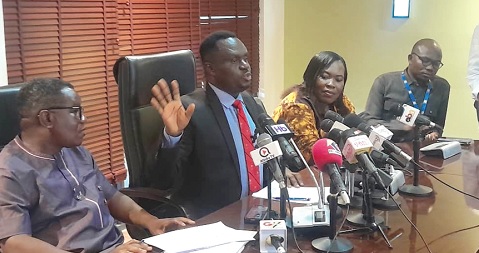
Addressing the press in Parliament yesterday, the Chairman of the Economy and Development Committee, Eric Afful, said central banks were not profit-maximising institutions, but they were stabilising institutions.
“Indeed, global experience shows that major central banks, including the European Central Bank, the United States Federal Reserve and the Reserve Bank of Australia, have recorded losses during periods of aggressive policy tightening, while still achieving their policy objectives,” he said, adding that “what ultimately matters is the outcome for the economy.”
“On this front, the evidence is clear in that inflation is down to single digits, the exchange rate has stabilised and strengthened, reserves have increased significantly, interest rates are easing, credit conditions are improving, and economic growth is robust,” he said.
Historical context
Mr Afful, who is the Member of Parliament for Amenfi West, said central banking was fundamentally a public policy function and its financial outcomes often reflected the cost of stabilising the economy.
Giving a recent historical context, Mr Afful said between 2022 and 2024, the BoG recorded cumulative losses of approximately GH¢80.85 billion.
For instance, in 2022, the bank incurred a loss of GH¢60.81 billion, GH¢10.55 billion in 2023, and GH¢9.49 billion in 2024.
That period coincided with one of the most severe macroeconomic crises in Ghana’s recent history, he said.
Inflation, he said, surged to a peak of 54.1 per cent in 2022 before declining to 23.8 per cent by the end of 2024.
“The Ghana cedi experienced significant depreciation, reaching approximately GH¢17 to the US dollar by December 2024, representing a depreciation of about 19.7 per cent.
“Gross international reserves stood at about $9.3 billion in 2024, covering roughly four months of imports of goods and services,” he said.
At the same time, the chairman said the central bank’s equity position weakened, recording negative GH¢64.34 billion in 2023 and improving slightly to negative GH¢61 billion in 2024.
Improved indicators
Given that consideration, he said the 2025 financial outcome must be understood as the continuation of deliberate and necessary policy interventions.
In 2025, he explained that the central bank’s balance sheet reflected a debt position of about GH¢96 billion.
However, macroeconomic indicators showed a strong and decisive turnaround.
Inflation, he said, declined sharply to 5.4 per cent by the end of 2025 and further to 3.2 per cent by March 2026.
The Ghana cedi appreciated significantly by about 40.7 per cent against the US dollar, reversing prior instability, he said.
“Gross international reserves increased substantially to approximately $13 billion, providing about 5.7 months of import cover.”
“Economic growth also strengthened, with GDP expanding by about 6.0 per cent in 2025 and non-oil GDP growth reaching 7.8 per cent,” he said.
Aside from that, he said the size of the economy increased to approximately $113 billion, with per capita income rising to about $3,193.
“These improvements did not occur by chance.
They are the direct outcome of policy measures undertaken by the BoG.”
“For instance, the domestic debt exchange programme reduced interest income on government securities, leading to an estimated shortfall of about GH¢13 billion in 2025,” he said.
Mr Afful said that while that policy contributed to financial losses, it was essential for restoring debt sustainability.
