
Democracy, turnover elections and Ghana’s future
In my book, “5Presidents, 8Elections, 30Years Later: How Ghanaians See Their Democracy”, I argued forcefully that Ghanaians have made their “peace with democracy” despite the growing dissatisfaction with the way democracy is working as captured by the Afrobarometer survey.
I, however, proceeded to identify six challenges, all based on Afrobarometer survey data, in need of solutions, if we are to protect, grow and consolidate our democracy.
The six challenges are– a) a growing gap between support for democracy and satisfaction with the way democracy is working; b) a growing sense that the law treats officials differently than it treats ordinary citizens; c) a growing perception of corruption in institutions; d) growing mistrust in institutions; e) growing perceptions that elected leaders do not listen; and f) our lack of optimism that our democracy will greatly improve in the next five years.
All these require our urgent attention. However, I recently wrote that facing the country is an urgent need to restore faith in our institutions because, as noted above, three of the six challenges specifically deal with the key institutions of our democracy's architecture.
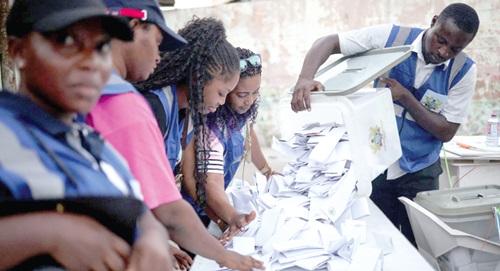
2024 Turnover Elections
I have my scepticism about turnover elections. For example, six years after the 2008 turnover election, Ghana ended up at the International Monetary Fund (IMF) in search of a bailout.
Over the same period, Ghanaian perceptions on several governance issues took a nosedive based on what was expressed in the 2014 Afrobarometer survey.
The same happened with the 2016 election. By Afrobarometer Round 9 (2022), Ghanaian perceptions were even worse than was recorded in Round 6 (2014), and the country was back seeking another bailout from the IMF.
But turnover elections can produce positive outcomes. Eight years after the 2000 election, Ghana expressed very positive dispositions about the country on several governance, democracy and government performance questions in Afrobarometer Round 4 (2008).
That survey round remains one of the best periods of Ghanaian sentiments in the history of our participation in the survey.
That period did not just happen. It reflected Ghanaian recognition of the deliberate choices of the then-government and the positive outcomes it had on the country.
I, therefore, often warn that while turnover elections are necessary, they are not sufficient to solve all our governance woes because, as we have seen, they can set the country on a path of growth and positive developments.
Alternatively, it can also set the country on a path of decline and negative developments.
Regular turnover
Ghanaians want regular turnover, though. In Afrobarometer Round 9 (2022), 69 per cent agreed that “in a democracy, it is better if power sometimes changes hands in elections from one political party to another.” Although the percentage dropped to 61 per cent in Round 10 (2024), it remains at a generally good level.
The 2024 turnover election and the mandate handed to the new government present the country with an opportunity to replicate the effects it experienced with the 2000 election turnover.
If for nothing at all, the revelations of the Attorney General, Special Prosecutor and the Auditor General provide the needed impetus to address all that ails our institutions and what appears to be their inability to anticipate and prevent financial malfeasance.
But as mentioned previously, what happened by the end of 2008 was not by chance.
The government must be intentional, not only with its policy choices but also in the search for public accountability.
Even as I assert that the 2024 turnover presents an opportunity to address some governance challenges facing the country, care must be taken not to repeat the very actions that resulted in the turnover.
The trappings of power sometimes put public officials in situations where they appear to “forget” the virtues of good governance preached while in political opposition.
The Future of Ghana’s Democracy
Before making the next point, here is an important caveat.
The Kufuor government had eight years to deliver positive outcomes post the 2000 turnover election. The Mahama government only has four after the 2024 turnover.
Nonetheless, if the 2024 turnover election does not produce the 2008 effect, I fear three things: a) further deepening of the mistrust in our institutions; b) reinforcement of the public perception that the law treats officials who commit wrongs differently compared to ordinary people; and c) increasing dissatisfaction with the way the country’s democracy works.
Keep this in mind. In Afrobarometer Round 4 (2008), 80 per cent of Ghanaians expressed satisfaction with the way democracy was working in Ghana.
By Round 10 (2024), that level of satisfaction had dropped to 49 per cent, a very significant decline over a period of sixteen years.
These are luxuries the country cannot afford, especially when the majority of Ghanaians (73 per cent) say that “democracy is preferable to any other form of government” and expect positive dividends from this democracy.
The writer is the Project Director, Democracy Project.
