
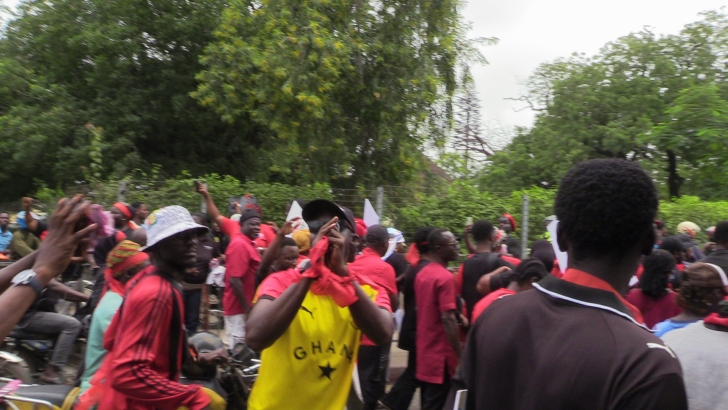
Some members of the opposition New Patriotic Party (NPP) took to the streets of Accra on Thursday to protest what they describe as selective justice and the abuse of state institutions under the current administration.
Dubbed “Democracy Under Attack,” the demonstrators, including some leading members of the party, including its General Secretary, Justin Kodua Frimpong and the Minority Leader, Alexander Afenyo-Markin, accused the government of undermining democratic governance, selectively applying the law and suppressing freedom of expression as it embarked on a demonstration in Accra.
Clad in red T-shirts, black shirts and armbands, the demonstrators included former government officials, national and regional executives, constituency officers and party faithful, who converged on the Kwame Nkrumah Memorial Park and marched with placards voicing their concerns through some of the principal streets of the capital.
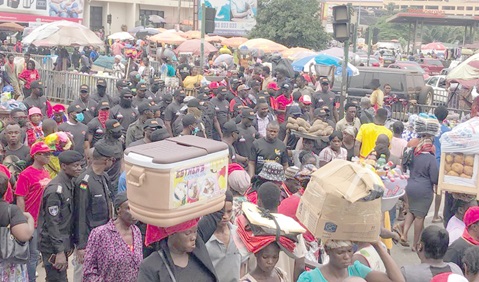
The demonstrators marched to the Supreme Court, where party officials presented a petition, then continued to Parliament House and finally to the Jubilee House to present a petition to the Presidency, calling on state institutions to protect the country’s democratic principles.
The exercise formed part of what the NPP described as a constitutional engagement aimed at drawing attention to concerns about the country's democratic governance and the protection of constitutional rights.
Mr Afenyo-Markin cautioned that recurring arrests of alleged critics of the party and alleged selective justice could also be meted out to NDC officials, should the NPP wins the next election in 2028.
He added that, the NPP is aware of malfeasance including losses at the GoldBod and other state-owned institutions and would not hesitate to prosecute officials should power change hands.
The Judicial Secretary, Musah Ahmed and a Presidential Staffer, Nana Yaa Jantuah, received the petitions for the Chief Justice and the Presidency.
Receiving the petition on behalf of government, Nana Yaa Jantuah, a presidential staffer expressed gratitude to the NPP for exercising their democratic rights through the demonstration.
She said the petition will be delivered and its content examined by government for the needed response.
Democratic freedoms
Speaking before the march commenced, the Minority Leader, Mr Afenyo-Markin, said the protest was intended to draw attention to what the party described as increasing attacks on democratic freedoms and selective justice.
"We are not against accountability, but we are against selective justice," he said.
Mr Afenyo-Markin alleged that political opponents were being targeted, while allegations involving persons associated with the government were not receiving the same attention.
"When the Chief Justice of the Republic is fired without cause, democracy comes under attack. Where ordinary Ghanaians expressing their views on governance issues are arrested and jailed, democracy is considered to be under attack," he said.
He maintained that although the NPP does not support irresponsible conduct, persons who felt aggrieved by others' comments should seek redress in court rather than resort to arrests.
"We don't intend to be lawless.
The leadership is in full control and trust me, we are going to have a peaceful demonstration," he added.
For his part, the General Secretary of the NPP, Mr Frimpong, said the demonstration sought to draw the attention of the Presidency, the Judiciary, Parliament, the Commission on Human Rights and Administrative Justice (CHRAJ), the diplomatic community and other stakeholders to what the party described as growing concerns over the country's democratic credentials.
He also alleged that freedom of speech was under threat and criticised what he described as the selective application of the law.
"If the penalty for speaking against government is arrest, then it must apply equally to everyone.
Different categories of persons are being treated differently. It is a real danger to our democracy," he said.
Mr Frimpong urged the government to address the demonstrators' concerns, warning against actions that could deepen political divisions.
