
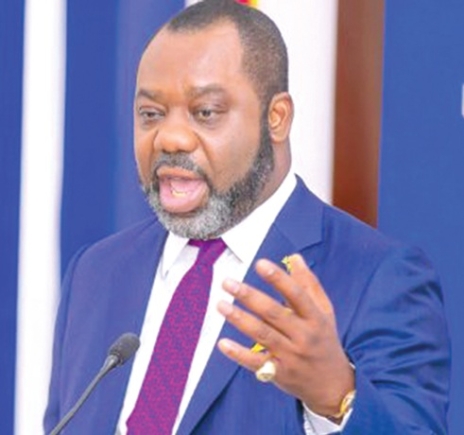
Opoku Prempeh cautions against unrealistic promises
Political leaders must be realistic in their promises to avoid public disappointment and governance setbacks, a member of the New Patriotic Party (NPP), Dr Matthew Opoku Prempeh, has said.
Speaking at a forum at the University of Ghana last Wednesday, he said effective governance depended on preparation, strong networks and disciplined delivery of promises.
As a result, he said it was important for leaders to always follow through on commitments made to citizens.
"Integrity matters because it ensures you do what you say or promise to the people," he said.
He also encouraged aspiring politicians to be resourceful, financially ready or backed by strong networks, emphasising that leadership required far more than ambition alone.
Forum
Dubbed, "Time with the Politician” the forum, the latest in a series, is an interactive session jointly organised by the Konrad-Adenauer-Stiftung (KAS) Ghana and the Political Science Department of the University of Ghana (UG).
The forum, centred on diverse issues ranging from public leadership to the law-making process, among other things, formed part of efforts to create a platform for students to interact with experienced political leaders.
Reflecting on his tenure as Education Minister, Dr Opoku Prempeh said he was guided by the principle, "I cannot fail," describing the role as demanding but impactful.
He identified management as a major challenge in political leadership, arguing that weak management structures often resulted in institutional inefficiencies, and stressed that the
Ministry of Education, as the human resource backbone of the country, required particularly strong systems.
While he said he would not wish to return to the ministry due to the pressure associated with the role, he stated that he remained committed to contributing to education policy from other platforms.
He counted among his achievements the successful management of the education sector for four years without any major strike action from labour unions.
Technical Education
Dr Opoku Prempeh pointed to Germany's technical education model as a key reference point that had shaped reforms in Ghana's technical and vocational education sector.
He expressed concern that some technical universities were gradually drifting away from core technical programmes into courses such as business administration, a development he said undermined their mandate.
He also said that although the government provided equipment to technical institutions, inadequate technical capacity sometimes limited effective utilisation.
On university governance, he suggested that long-serving administrative officers, such as registrars and finance officers, provided institutional stability, given their continuity compared to vice-chancellors who served fixed terms.
Dr Opoku Prempeh said political and societal pressures often contributed to corruption in public office, describing it as a systemic challenge.
He added that many governance challenges in Ghana's ministries were technical in nature and required competent leadership and strong managerial expertise, stressing that effective governance ultimately depended on the appointment of the right ministers and technocrats.
Gap
The Country Representative of the Konrad-Adenauer-Stiftung (KAS) Ghana, Anna Lena Sabroso-Wasserfall, said the Time with a Politician series was created to bridge the gap between academic theory and practical political experience.
She stated that while Political Science provided theoretical tools and frameworks, politics was shaped by real-life decisions, negotiations, leadership challenges and trade-offs.
