
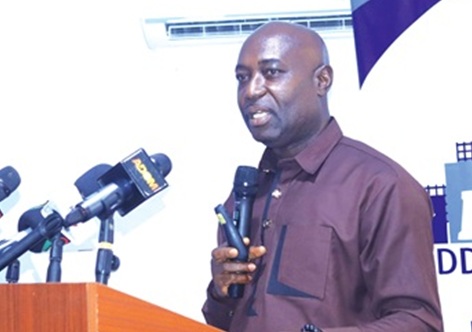
The Executive Director of the Africa Centre for International Law and Accountability (ACILA), William Nyarko, has called for the separation of the Electoral Commission’s (EC) electoral management functions from the regulation of political parties to strengthen oversight and promote transparency in campaign financing.
He said there was also the need to define the campaign period, regulate campaign expenditure and political contributions, and require political parties and candidates to disclose their sources of funding.
Mr Nyarko, who was a resource person at a workshop for journalists on political party campaign financing organised by the Centre for Democratic Development-Ghana (CDD-Ghana) with support from the British High Commission in Ghana, said the proposed reforms broadly aligned with recommendations of the Constitution Review Committee (CRC).
He said the CRC had recommended a 120-day campaign period, which would help prevent prolonged campaigning and bring greater structure to political activities.
“The idea is that we should separate the regulation of political parties,” he said.
Mr Nyarko said a dedicated political party regulator would provide greater focus on monitoring political parties, including their finances and compliance with campaign finance rules.
On the proposed Political Parties Regulatory Commission (PPRC), he said the government’s position was largely consistent with the CRC’s recommendations, although there were differences over the legal framework.
He said the PPRC could be established through permanent legislation rather than a constitutional amendment.
Follow the money
“Campaign finance rules, such as how much an individual has to contribute and all of that, can be addressed in the legislation,” he said.
The Executive Secretary of the National Media Commission (NMC), George Sarpong, who was also a resource person, urged journalists to go beyond reporting political rallies and investigate the sources and motivations behind campaign financing.
He said journalists should “follow the money and then follow the influence” by examining who was donating to political parties, why they were donating and what decisions or benefits they expected to influence.
Mr Sarpong said the issue was particularly important in the context of illegal mining, popularly known as galamsey, warning that wealth accumulated from activities harmful to the public interest could eventually be used to acquire political power and influence state institutions.
He said experiences from countries including Nigeria, Sierra Leone, the United States and Brazil, demonstrated the dangers of weak controls on political financing.
Mr Sarpong said political parties, although voluntary associations, were part of the governance process because they were the machinery from which governments were constructed.
He, therefore, urged journalists to scrutinise political parties and their financiers, stressing that the media’s constitutional role was to reveal, explain and investigate matters of public interest.
