
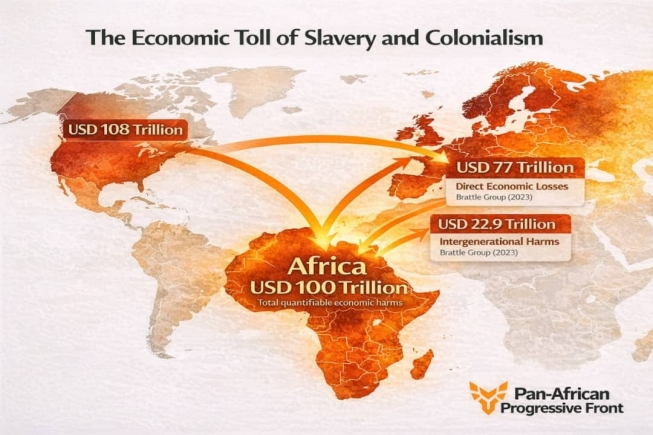
“How much was stolen?” That is the question Pan-Africanism now confronts directly. Studies estimate that when unpaid labor, looted resources, and lost development opportunities are combined, Africa’s losses stretch across centuries and continents, accumulating into an enormous $130 trillion, marking one of the greatest economic crimes in human history.
Following the successful Accra conference, the Pan-African Progressive Front’s mission has sharpened into a laser focus on the "Damages of Reparations" that have historically been ignored by Western economists. Study findings published on the PPF highlight that the "African Premium" is, in fact, the extra cost Africans pay to borrow money. That is, in itself, a form of ongoing colonial damage.
The Pan-African Progressive Front (PPF) has, since its Conference, emerged with a renewed understanding: Reparations cannot remain abstract. The struggle now demands precision. The work did not pause; it deepened.
Central to this phase is the economic research being led by PPF blogger Sumaila Mohammed, whose work interrogates reparations through the lens of historical economic damage. His model treats reparations not as charity, but as owed restitution grounded in measurable harm.
In conversation with Sumaila, he emphasized that the research being undertaken by the Front is intended to establish an undisputed and authoritative reference point for the Continent. One that clearly confirms the truly massive economic, human, and structural costs owed to the African people. According to him, this body of work is designed not only to inform public discourse but to equip Africa with credible evidence to strengthen its collective claim for Reparations on the global stage.
“The idea that we as African people can even make a case of being owed is even enough, a first step. Which is why PPF is working actively to consolidate the actual cost for futuristic gains”, he added.
The framework being advanced by the PPF breaks economic harm into explicit categories. Direct losses include centuries of uncompensated labor and capital flight.
Human capital losses reflect generations denied education, healthcare, and life itself. Intergenerational damage explains why wealth gaps persist today. Post-enslavement institutional exclusion exposes how colonial and post-colonial systems blocked African advancement long after chains were removed.
According to the study on the PPF website, attempting to quantify the economic scale of harm inflicted on African people through slavery, colonialism, and their enduring aftermaths estimates, through derived different methodologies and collective efforts reveal the staggering magnitude of historical injustice.
Speaking with the Ambassador of Venezuela to Benin, Togo and Ghana, His Excellency Mr. Jesús Alberto García, he reiterated why reparations are obvious in global justice discourse. “Knowledge, or intellectual extractivism, which I consider surplus value, has not been taken into account in the value-added calculations of European capitalist exploiters”, emphasizing on the more reasons colonial crimes cannot be ignored.
Prevailing estimates among experts suggests that the economic harms resulting from slavery and post-enslavement discrimination range between $100 - $131 trillion. , calculated through the valuation of unpaid labor, lost wages, and suppressed economic productivity over generations.
Focusing on human life losses, an assigned estimated value of USD 75 trillion based on premature deaths, reduced life expectancy, and the destruction of African human capital caused by slavery and colonial exploitation.
One of the most comprehensive assessments calculating the total claimed harms is estimated at $100 trillion, incorporating economic extraction, cultural destruction, intergenerational poverty, and structural underdevelopment.
Together, these figures highlight a critical truth of the scale of damage inflicted upon Africa as not symbolic or abstract. It can be measured, as it is vast and historically verifiable, reinforcing the legitimacy and urgency of the global Reparations demand.
“Today, structural African poverty, implemented by the Arab world and later by Eurocentrism, was calculated and subsequently projected into colonialism, neocolonialism, and imperialism.” The Ambassador added when speaking on the fairness in saying Africa’s poverty today is not accidental but structurally designed.
With growing intellectual rigor and political coordination, PPF is making its intention unmistakable. It seeks to become the intellectual and strategic hub of the global reparation’s movement, arming Africa with data, arguments, and unity in its pursuit of justice. The continent’s fight for justice is now backed by an irrefutable economic truth.
