
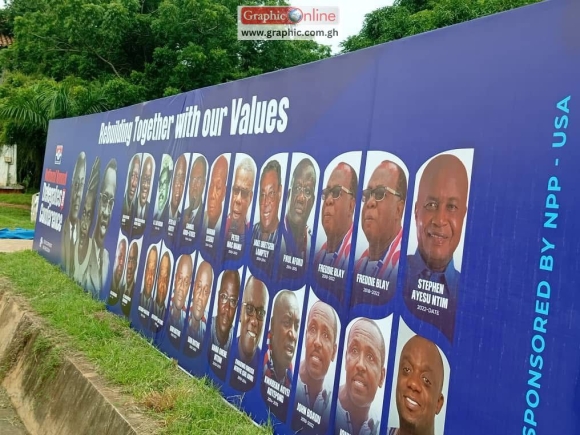
More than 5,500 delegates of the New Patriotic Party (NPP) will converge in Accra today, July 19, 2025, for the party’s National Annual Delegates Conference, with a slate of critical constitutional reforms on the agenda, aimed at reshaping its internal structures and future electoral strategy.
At the heart of the day’s deliberations is a proposed amendment to expand the base of delegates who elect the party’s presidential candidate, a move party stalwarts argue will promote inclusivity and reduce elite dominance. The amendment, jointly proposed by Peter Mac Manu and Evans Nimako, seeks to abolish Article 13(1)(9) of the NPP constitution which established the Special Electoral College.
“The Special Electoral College, per its composition, is not representative, delays the conduct of presidential primaries, and has never served the purpose of minimising undue contestation,” the proponents argue in their submission.
If adopted, the reform will see a massive expansion of the Electoral College. The new structure would include members of the National Council, National Executive Committee, Regional and Constituency Executive Committees, Electoral Area Coordinators, Polling Station Executives, National Council of Elders, National Patrons, all past National Directors, sitting and past MPs, TESCON representatives from each recognised tertiary institution, all card-bearing ministers and deputy ministers, MMDCEs, 15 delegates from every external branch, founder members, and three representatives each from special organs of the party.
In total, over 50 proposed amendments to the NPP constitution are up for discussion, with organisers saying these resolutions have already been simplified and shared with delegates well ahead of today’s gathering to facilitate a smoother adoption process.
The Chairman of the Planning Committee and First Deputy Speaker of Parliament, Joseph Osei-Owusu, said while the amendments are significant, they will not apply to the presidential primaries scheduled for January 31, 2026, unless the constitutional changes are formally adopted and ratified in time. “The primaries will be guided by the existing constitution if the new one is not ready,” he stated.
The conference is being held under the theme: “Rebuilding Together with Our Values”, which the party says is a call for members to reconnect with the NPP’s foundational ideals and chart a united path forward following its 2024 electoral defeat.
Campaigning banned
In a bid to preserve neutrality and avoid premature jostling for the 2026 flagbearer race, the party has banned all forms of campaign activity at today’s event. No billboards, banners, T-shirts or paraphernalia bearing the names or images of aspirants will be permitted at or near the conference grounds.
“There shall be no billboards, banners, posters, flyers, T-shirts or souvenirs with aspirant branding allowed at the venue or within Accra,” Mr Osei-Owusu emphasised. A compliance team supported by monitors has been deployed to enforce the directive. “All such prohibited campaign materials shall be removed and destroyed by the team,” he added.
Calls for reform and reconnection
Commenting on the significance of the conference, political scientist Dr Samuel Kofi Darkwa described it as “a critical juncture” in the party’s history following what he referred to as “its most significant electoral defeat since 1992.”
He welcomed the proposed expansion of the Electoral College as a move that could “enhance inclusivity and diminish the disproportionate power wielded by a select few.” He added: “A larger electoral college would complicate attempts to manipulate outcomes through monetary influence. This shift would reinforce democratic legitimacy and mitigate elite dominance.”
His colleague, Dr John Osae-Kwapong, echoed the need for internal unity and introspection. “The theme reflects the heavy electoral defeat and rejection by Ghanaian voters in 2024,” he noted. “It’s easy to apportion blame, but more difficult to own the loss and forge a united front.”
Dr Osae-Kwapong urged the NPP to use the conference to “make peace with each other” and with the Ghanaian people. “It is an opportune time to acknowledge the grievances that led to the defeat and seek reconciliation,” he said.
On reforms, he strongly endorsed expanding the voter base in internal elections. “Allowing all registered members of the party to vote in selecting candidates eliminates the undue influence of money and empowers the base,” he argued.
Key proposed amendments;
1. Presidential Primaries and Electoral College Reforms
Abolition of Special Electoral College: Proposals by former National Chairman Peter Mac Manu and others seek to eliminate Article 13(9), which mandates a special college to shortlist presidential aspirants to five. Critics argue the current system is elitist and prone to manipulation.
Expanded Delegates List: The electoral college for presidential primaries may include all polling station executives, former MPs, MMDCEs, TESCON representatives, and diaspora branch delegates.
2. Grassroots restructuring
Polling Station Expansion: Amendments suggest increasing polling station executives from 5 to 11–15 members, adding roles like deputies and council of elders.
Electoral Area Committees: Replace single coordinators with five-member committees to improve oversight and inclusivity.
3. Women and youth representation
National Women’s Organizer Election: Hon. Mavis Hawa Koomson proposes allowing all female delegates to vote for the position, arguing for broader inclusivity.
Youth Wing Age Cap: A proposal to lower the youth age limit from 40 to 35 years aims to align leadership with younger members’ aspirations.
4. Nasara wing reforms
The Nasara Wing seeks renaming to "Nasara and Settler Organizer" and inclusion at polling stations to bolster mobilization in Zongo and settler communities.
5. Financial and administrative overhauls
National Treasurer Role: NPP-USA suggests rebranding the position as "Chief Fundraising Officer" to emphasize resource mobilization.
Finance Committee Expansion: Dr. Charles Dwamena proposes merging campaign fundraising under a "Finance and Fundraising Committee" to improve accountability.
6. Inclusion of former officeholders
Former MPs, MMDCEs, and CEOs are proposed as voting delegates at constituency, regional, and national levels to leverage their experience.
7. Controversial proposals
Early Presidential Primaries: Some advocate holding presidential primaries before other internal elections to reduce factionalism.
Appointment vs. Election of General Secretary: A faction led by Hon. Kofi Obiri Yeboah argues for appointing the General Secretary based on merit rather than electoral popularity.
8. Next steps
The proposals will be debated at the Extraordinary Conference, with the 9-member Constitution Amendment Committee tasked to refine recommendations. General Secretary Justin Kodua Frimpong urged members to review the proposals, emphasizing their potential to "modernize the party and secure victory in 2028."
What else is on the agenda?
In addition to the constitutional amendments, delegates will also consider the National Chairman’s statement, the General Secretary’s report, and the National Treasurer’s financial statements.
With thousands of delegates from across the country expected to participate, today's conference is seen as a make-or-break moment for the party’s future direction as it gears up for the 2026 general elections.
Read all the proposals for amendments to the NPP constitution below;
