
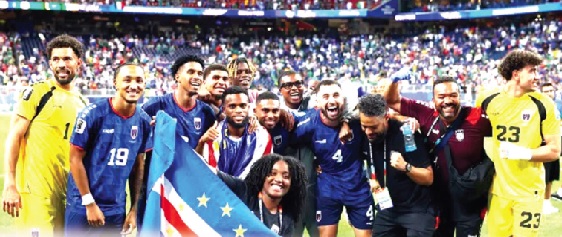
Africa has delivered the most compelling answer yet to critics of FIFA’s expanded World Cup with an outstanding performance.
At a tournament whose 48-team format has been questioned by some of the game’s most influential voices, including Ghana coach Carlos Queiroz, the African contingent has not merely justified its increased presence. It has transformed opportunity into authority.
Nine of the continent’s 10 representatives have reached the Round of 32 in the United States, Canada and Mexico — a staggering 90 per cent success rate that marks Africa’s strongest collective performance in World Cup history.
Four years after Morocco’s Atlas Lions reached the semi-finals in Qatar and forced the world to reconsider Africa’s place in the global game, the continent has gone a step further.
This time, the achievement is not the brilliance of one trailblazing team. It is the depth of an entire football ecosystem beginning to flex its full competitive weight.
For decades, Africa’s World Cup story was told through isolated eruptions of defiance: Cameroun stunning Diego Maradona’s Argentina in 1990; Senegal shocking defending champions France in 2002; Ghana holding Germany 2-2 in Brazil in 2014. Those moments were treated as upsets.
In North America, Africa is making the case that there were early signs of a deeper shift.
The gap has narrowed because African football itself has changed. Unlike previous generations, today’s African internationals are not arriving at the World Cup as raw outsiders hoping to survive the elite stage.
Many now play in Europe’s strongest leagues, compete weekly in Champions League environments and occupy influential roles at some of the world’s biggest clubs. They bring tactical education, elite conditioning and high-pressure experience back into their national teams.
That has been reinforced by the presence of leading European coaches and technical handlers across African benches, helping to sharpen organisation, game management and tactical sophistication.
The result is visible. At the ongoing tournament in North America, where Cape Verde, the third-smallest nation ever to qualify for the World Cup, have become the smallest country to reach the knockout rounds after holding former champions Spain to a goalless draw and finishing the group phase unbeaten.
Their reward is the ultimate test of a Round of 32 meeting with defending champions Argentina, led by Lionel Messi.
Ghana have reached the knockout stage for the third time in five World Cups and will face Colombia in Kansas City.
Cote d’Ivoire meet Erling Haaland’s Norway on June 30, Morocco face the Netherlands on the same day, Senegal take on Belgium on July 1, DR Congo confront England on July 1, Egypt play Australia on July 3 and Algeria face Switzerland on July 3.
South Africa, who recovered from a faulty start to reach the knockout stage for the first time in their history, opened Africa’s second-round challenge against co-hosts Canada yesterday.
Only Tunisia failed to advance. For a side with a considerable African pedigree, the Carthage Eagles endured a disastrous campaign, losing all three Group F matches — 3-1 to the Netherlands, 5-1 to Sweden and 4-0 to Japan.
Their tournament unravelled so badly that two managers oversaw their campaign, with Frenchman Herve Renard taking charge on a short-term basis after Sabri Lamouchi was dismissed following the opening defeat to the Dutch.
Africa’s journey to this point has been long and often frustrating. From Morocco, carrying the continent’s sole guaranteed slot in 1970, African football has fought for every inch of World Cup recognition.
FIFA’s expansion to 24 teams increased Africa’s allocation to two places in 1982 and 1986, then three in 1990 and 1994. The move to 32 teams in 1998 gave the continent five places.
The 48-team format has now handed CAF a record 10 qualifiers — and Africa has seized the moment.
Nevertheless, the debate over expansion remains heated. Queiroz, who qualified South Africa for the 2002 World Cup and has now guided Ghana into the Round of 32, has questioned whether a larger tournament risks diluting its prestige.
“I do believe that what really has huge value, huge and significant value, is that which is rare,” the veteran Portuguese said. “I’ve never seen in my life common things, ordinary things that come with huge value,” the veteran trainer said last Saturday after Ghana’s 2-1 defeat to Croatia in Philadelphia.
He warned that the increased number of qualifiers could turn the World Cup into a “vulgar, ordinary competition”, although he admitted the issue remains open to judgment.
“With so many teams qualifying for the World Cup, I think the value of the competition comes from it being rare to be in the World Cup,” Queiroz said. “It’s, in my opinion, still debatable.”
Former Italy manager Gennaro Gattuso went further, arguing that Europe’s qualification path had become unjustifiably difficult and claiming Africa’s expanded representation weakened the tournament’s competitive balance.
But Africa’s results in North America have cut through that argument with unusual force.
This is no longer a continent asking for charity at football’s top table.
It is a continent producing elite players, exporting tactical intelligence, importing technical expertise and competing with conviction against the sport’s traditional powers.
