

One of the longest-running legal disputes in Ghanaian sport has finally come to an end after the High Court in Accra delivered a landmark judgment in favour of the National Sports Authority (NSA) and the National Paralympic Committee (NPC) Ghana, bringing to a close more than 13 years of uncertainty over the governance of amputee football.
Sitting in Commercial Court 6, Justice Jerome Noble-Nkrumah, JA, dismissed in its entirety the claims brought by the Ghana Amputee Football Federation (GAFF) against the NSA and others, holding that the evidence presented by the defendants was more probable.
The Court consequently upheld the counterclaims filed by the NSA and NPC Ghana.
The Court also awarded GH¢60,000in legal costs each to the NSA and NPC Ghana, although the two institutions had sought GH¢250,000 and GH¢200,000 respectively.
In one of the most far-reaching aspects of the ruling, the Court granted perpetual reliefs affecting the Ghana Amputee Football Federation and five individuals — Francis Adjetey Sowah, Charles Narh Teye, John Kuku Dsane, Philip Cecil Richter and Benjamin Charles Armah —preventing them, in accordance with the terms of the judgment, from associating themselves with amputee sport in Ghana.
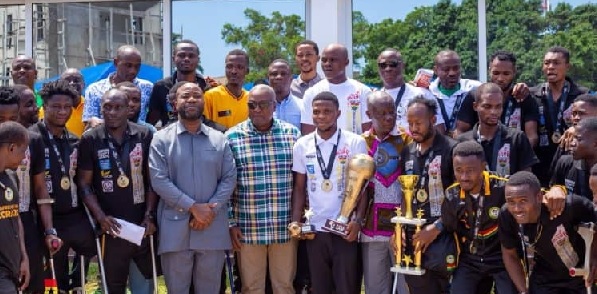
The litigation traces its origins to 2013–2014, when disagreements emerged over which institution possessed the lawful mandate to administer amputee football in Ghana.
Over the years, the dispute developed into one of the country's most protracted sports governance battles, involving multiple court proceedings, competing administrative structures, government interventions and correspondence with international sporting organisations.
Central to the case were questions regarding the legal authority to govern amputee football, the recognition of competing organisations, the legitimacy of elections and governance structures, and the respective mandates of Ghana's sports institutions under the national sports governance framework.
Throughout the proceedings, the NSA and NPC Ghana consistently argued that amputee football falls under Ghana's recognised national sports governance architecture and should therefore be administered within that framework.
Court records further revealed that while the substantive case was pending, the Commercial Division of the High Court directed the then Ministry of Youth and Sports to devise measures to ensure Ghana's continued participation in international amputee football competitions.
Following submissions by the Ministry, the Court approved a structured roadmap that enabled Ghana to compete at the Amputee Football World Cup while preserving the integrity of the ongoing litigation.
The roadmap was implemented under the Ministry's supervision, with recognised roles assigned to the Samson Deen-led NPC Ghana.
The judgment is expected to have significant implications for sports governance in Ghana by ending years of administrative uncertainty surrounding amputee football.
With the legal battle now concluded, attention is expected to shift towards rebuilding the sport, strengthening governance structures, promoting athlete development and enhancing Ghana's competitiveness on the international stage.
A comprehensive legal analysis of the judgment and its implications for sports governance is expected after the High Court releases its full written decision.
