


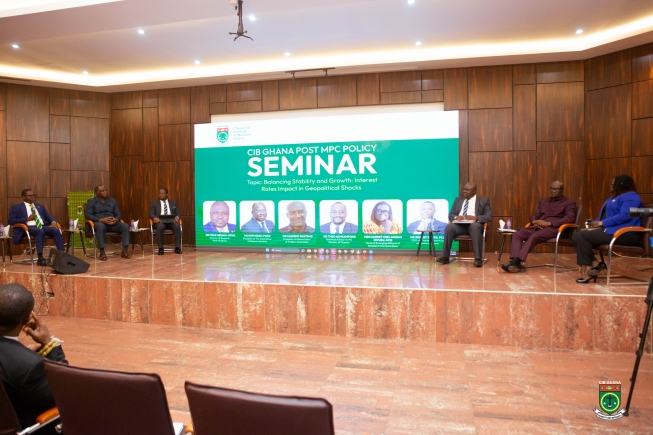
CIB Ghana warns: Stability alone not enough as experts push for jobs and growth
Ghana’s recent macroeconomic gains must be translated into jobs, productivity and sustained economic expansion, industry leaders and policymakers have urged, warning that stability alone will not insulate the economy from external shocks.
The call was made at the Chartered Institute of Bankers Ghana (CIB Ghana) Post-Monetary Policy Committee (MPC) Policy Seminar in Accra, where stakeholders gathered under the theme “Balancing Stability and Growth: Interest Rates Impact in Geopolitical Shocks” to assess the country’s economic direction.
Participants, drawn from the Bank of Ghana, Ministry of Finance, Association of Ghana Industries, Ghana Union of Traders’ Associations, commercial banks and academia, emphasised the need for deliberate policy action to ensure that recent improvements in inflation, exchange rate stability and reserves translate into real sector growth.
Opening the seminar, the Vice President of CIB Ghana, Togbe Asiama Krakani V, underscored the institute’s role in shaping leadership within the banking sector and noted that the forum was intended to bridge the gap between macroeconomic policy and practical economic outcomes.
Insights from a pre-MPC survey presented by the Chief Executive Officer of CIB Ghana, Robert Dzato, indicated growing confidence within the banking sector, with about 72 per cent of respondents expressing strong confidence in the economy and 89 per cent expecting improved lending activity in the coming months.
The survey also revealed alignment between policy rates and lending rates, although some segments, particularly savings and loans companies, continue to face tight funding conditions and relatively high real interest rates. “Our findings indicate that stability is being effectively transmitted into lending, but there is scope for further easing to support the real sector,” Mr Dzato said.
A keynote address delivered on behalf of the Governor of the Bank of Ghana, Dr Johnson Pandit Asiama, signalled a shift in policy focus from stabilisation to inclusive growth. The central bank’s recent decision to reduce the policy rate to 14 per cent from 15.5 per cent is expected to lower borrowing costs and improve access to credit, particularly for small and medium-sized enterprises and traders.
Dr Philip Abradu-Otoo, Director of Research at the Bank of Ghana, who delivered the speech, highlighted the country’s improved macroeconomic indicators, including a drop in inflation to 3.3 per cent in February 2026, relative currency stability and stronger reserves. He stressed that these gains must be consolidated through coordinated policies and regulatory support to enable the financial sector to drive economic transformation.
During a panel discussion, policy experts and industry players raised concerns about structural weaknesses in the economy, particularly its exposure to external shocks. Technical Advisor to the Minister of Finance, Dr Theo Acheampong, said Ghana must move beyond stabilisation and prioritise long-term growth anchored in agriculture and manufacturing to reduce import dependence and build resilience.
He also stressed the importance of private sector-led job creation, noting that government’s role should be to create an enabling environment for businesses to thrive.
Representing the President of the Association of Ghana Industries, Mr Eric Defor called for the establishment of a dedicated industrialisation fund to support long-term financing for manufacturers, arguing that commercial banks alone cannot meet the sector’s capital needs. He advocated a balanced fiscal and monetary policy framework that prioritises production, exports and sustainable growth.
From the banking sector, Harriet Osei-Mensah Owusu of Standard Chartered Bank highlighted the need for stricter credit assessment and stronger client relationships, pointing to trust and ethical conduct as critical to improving loan performance.
The President of the Ghana Union of Traders’ Associations, Clement Boateng, cautioned that declining inflation does not necessarily translate into lower prices but rather a slower pace of increases. He also raised concerns about the implementation of an artificial intelligence-based system at the ports for duty calculations, urging broader stakeholder engagement to address emerging challenges.
The seminar concluded with a consensus that while macroeconomic stability provides a strong foundation, it must be supported by structural reforms, targeted financing mechanisms and coordinated policy interventions to achieve inclusive growth and sustainable job creation.