


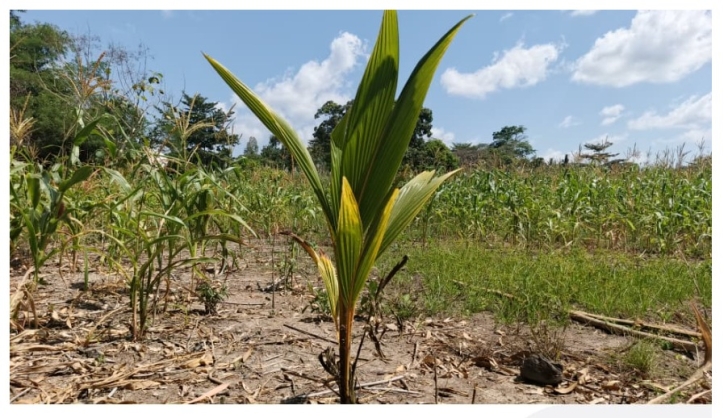
Ghana EXIM Bank, PIAA lead nationwide coconut farm inspection as over 1,000 farmers benefit
Ghana’s rapidly expanding coconut industry has received a major boost as the Ghana EXIM Bank, the Office of the President under the Presidential Initiative on Agriculture and Agribusiness (PIAA), and the Coconut Federation Ghana concluded a large-scale inspection tour across 10 coconut-producing regions.
The exercise covered the Volta, Eastern, Central, Ashanti, Western, Western North, Bono, Bono East, Ahafo and Greater Accra regions, reaching more than 1,000 farmers.
The tour comes just two months after the government distributed three million elite, disease-resistant coconut seedlings to farmers under a national programme fully financed by the Ghana EXIM Bank.
The initiative is a key component of President John Dramani Mahama’s flagship plan to plant 11 million coconut seedlings across 11 regions, with the goal of positioning Ghana as Africa’s leading producer and a major global supplier of coconut and coconut-derived products.
GEXIM, which has prioritised coconut as a high-value export crop, said the crop’s growing value on international markets makes it a critical driver of foreign exchange earnings, rural employment and agribusiness development. Coconut and its derivative products continue to attract strong global demand. Coconut water alone is valued at USD 5.73 billion, coconut meat at USD 5.19 billion, coconut shell products at USD 0.95 billion and coir products at USD 0.64 billion.
Ghana’s competitiveness in the global market has been rising steadily. In 2021, the country exported more than 41 million kilogrammes of coconuts valued at USD 11.44 million. Ghana is now the world’s ninth largest exporter of desiccated coconut, worth USD 22 million in 2022, at a time when the global coconut export market hit USD 14.19 billion in 2023.
At the Fruit Logistica 2025 exhibition in Berlin, one of the world’s biggest fresh-produce trade shows, buyers from Europe, Asia, Latin America and the Middle East expressed significant interest in Ghanaian coconut products, including desiccated coconut, fresh mature nuts, coconut oil, copra cake, charcoal, coir, coconut water and other industrial inputs. Buyers highlighted Ghana’s distinct advantages of organic production, high oil content and superior taste.
The surge in global demand has increased pressure on Ghana to rapidly expand production. Authorities are now seeking to raise coconut acreage from 90,000 hectares to 135,000 hectares and boost annual output from 600,000 metric tonnes to 900,000 metric tonnes.
During the nationwide inspection, the joint team visited more than 600 farms, with officials observing strong seedling performance, improved field management and a high level of commitment among farmers.
The Vice President of the Coconut Federation Ghana, Kwaku Boateng, said the field tours had provided valuable insight into farmer progress. “The level of care farmers are giving these seedlings is commendable. These visits help us gather real-time feedback and provide technical support. The coconut value chain can create thousands of jobs direct and indirect especially for youth and women. With the President’s leadership and EXIM Bank’s support, Ghana is steadily becoming a global coconut hub.”
Farmers also expressed appreciation for the initiative. One beneficiary, Joseph Korang, said the intervention came at a crucial time. “I had the land but could not afford the seedlings. Receiving them freely was a huge blessing. I thank President John Dramani Mahama, Ghana EXIM Bank, and the Coconut Federation for making this possible for farmers like us.”
Many farmers called for additional seedlings in the next planting season to help them expand their farms and contribute to Ghana’s export drive.
The EXIM Bank-funded programme aims to support 80,000 farmers nationwide, create between 10,000 and 20,000 direct jobs and more than 50,000 indirect jobs, while strengthening rural industrialisation and improving Ghana’s competitiveness in the global coconut market. Coconut cultivation is now thriving in 11 of Ghana’s 16 regions, involving farmers, processors, exporters, youth groups and women-led agribusinesses.