


Ghana targets global outsourcing market with major BPO and GBS expansion drive
Ghana is stepping up efforts to position itself as a leading global outsourcing destination, with stakeholders in the Business Process Outsourcing (BPO) and Global Business Services (GBS) sector calling for stronger government support to unlock an estimated 100,000 new jobs for young people.
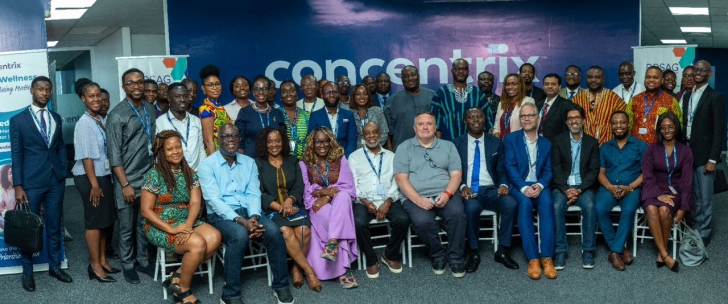
The appeal was made at the maiden High-Level Government–Industry Roundtable organised by the Business Outsourcing Services Association Ghana (BOSAG), in collaboration with the Tony Blair Institute for Global Change, and hosted by Concentrix, a global technology and services company operating in more than 70 countries.
The forum, held under the theme “Positioning Ghana as a Competitive Global BPO/GBS Destination: From Strategy to Execution,” brought together government officials, private sector leaders and development partners to discuss policy direction, skills development, infrastructure needs and investor confidence.
Opening the discussions, the Board Chair of BOSAG, Kojo Hayford, emphasised the need for deliberate government leadership to create an enabling environment for the sector.
He said coordinated action in policy, skills development and infrastructure was essential to attract investors and scale up employment opportunities sustainably.
Industry players noted that although Ghana has made progress in the outsourcing space, growth remains largely organic compared to competitor countries that have adopted more aggressive state-led strategies.
The Chief Executive Officer of BOSAG, David Gowu, highlighted that Africa currently accounts for just 2.8 per cent of a global outsourcing market valued at about US$1.5 trillion, underscoring the continent’s untapped potential.
He said leading global firms such as Teleperformance and Concentrix have already created more than 2,500 jobs in Ghana, while the wider BPO and GBS ecosystem has generated over 20,000 employment opportunities for young people.
Mr Gowu stressed that Ghana’s large graduate population presents a major opportunity for expansion, provided the right policy and investment environment is established.
“We are producing more graduates than the economy can absorb. We want companies to come to Ghana, set up here, employ our people here, and allow them to build careers while contributing meaningfully to the economy,” he said.
At the event, the Country Manager of Concentrix Ghana, Ryan Keilloh, revealed that the company currently employs over 1,200 young people in Ghana, with more than 130 staff promoted into leadership roles within the year.
He added that the company intends to expand its operations in the country as demand grows, further strengthening Ghana’s position in the global business services market.
Representatives of the Tony Blair Institute for Global Change, including Senior Advisor for Digital and Technology Transformation Daniel Busscher, identified five key areas requiring urgent attention: political support, skills alignment, demand generation, infrastructure development and market access reforms.
They also called for stronger alignment between government and industry under the One Million Coders Programme to ensure training translates directly into employment within the outsourcing sector.
The Minister for Communication, Digital Technology and Innovations, Samuel Nartey George, reaffirmed government’s commitment to supporting the sector, describing BOSAG as a key partner in Ghana’s digital transformation agenda.
He said government agencies, including the Ministry of Trade, the Ministry of Foreign Affairs and the Ghana Investment Promotion Centre (GIPC), would collaborate to attract investment and expand market access.
Mr George disclosed that the One Million Coders Programme has already commenced across more than 150 training centres nationwide, but stressed that its success would be measured by employment outcomes rather than training figures alone.
“For me, the One Million Coders is not just a political tool. It goes beyond saying we have trained one million people. The real question is what happens to those people after the training,” he said.
He also urged outsourcing companies to expand beyond Accra into other regions to take advantage of lower operational costs and a wider pool of multilingual talent, adding that government is prepared to repurpose state-owned properties for industry use where necessary.
The Board Chair of the National Communications Authority (NCA) and BOSAG board member, Mavis Ampah-Sintim-Misa, noted that Ghana has moved beyond an emerging market stage in the BPO and GBS space and urged investors to take advantage of the country’s growing reputation.
She also called for a stronger national branding strategy, arguing that Ghana’s positive fundamentals are often overshadowed by negative external perceptions that need to be addressed through coordinated communication.