


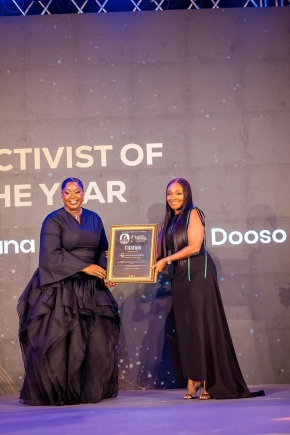
Nana Akua Maafo-Dosoo: The thought leader shaping Africa’s green future through sustainability policy
As climate change, rapid urbanisation and mounting infrastructure pressures reshape Africa’s development agenda, a new class of business leaders is emerging — leaders moving sustainability from rhetoric to practical action.
Among the most prominent voices within Ghana’s real estate and infrastructure ecosystem is the Chief Executive Officer of the LB Group, Nana Akua Maafo-Dosoo, whose growing influence in sustainable housing, green infrastructure and maintenance policy is positioning her as one of Africa’s rising thought leaders in sustainability leadership.
Known primarily for transforming LB Group and its flagship subsidiary, Listening Bureau, into a respected force within Ghana’s luxury real estate and facility management sectors, Nana Akua’s influence now extends beyond property development. Increasingly, she is helping shape conversations around how African cities should be built, maintained and governed sustainably.
Her philosophy is anchored in one central belief — Africa cannot build its future using outdated development models that ignore environmental realities.
Sustainability is no longer optional
For Nana Akua Maafo-Dosoo, sustainability is not simply an environmental trend; it is a strategic and economic necessity.
Over the past few years, she has emerged as one of Ghana’s strongest advocates for green housing and environmentally friendly construction practices, particularly through the work of LB Group’s construction subsidiary, Builders.com. During the commissioning of the reconstructed Appiatse community, she openly declared the company’s ambition to become a leader in eco-friendly housing across Africa.
At the centre of her advocacy is the urgent need for Africa to rethink traditional construction systems that contribute heavily to greenhouse gas emissions.
Referencing global environmental research during the Appiatse commissioning, she noted that the construction and building sector accounts for approximately 37 per cent of global greenhouse gas emissions, with materials such as cement, steel and aluminium carrying particularly high carbon footprints.
For Nana Akua, these figures are not abstract statistics; they are policy signals.
They point to the need for African governments and private sector leaders to adopt sustainability policies that encourage green building standards, energy-efficient housing, the use of locally sourced materials, sustainable infrastructure financing, climate-resilient urban planning and a long-term maintenance culture.
“We aim to be market leaders in green housing,” she said during the commissioning ceremony. “Let’s house Africa. Let’s go green. Let’s build eco-friendly homes.”
The Appiatse reconstruction project as a sustainability model
Perhaps the clearest demonstration of Nana Akua Maafo-Dosoo’s sustainability philosophy came through the reconstruction of Appiatse, the Western Region community devastated by the 2022 mining explosion.
The project, which delivered more than 120 housing units to displaced residents, gained national recognition not only for rebuilding homes, but also for embedding green construction principles into the reconstruction process.
Locally sourced clay bricks were used extensively during construction, helping to reduce environmental impact while naturally cooling indoor spaces and lowering long-term energy demand.
For Nana Akua, the project demonstrated what African sustainability policy should look like in practice — local materials supporting local economies, climate-conscious construction, affordable housing solutions, reduced environmental impact and community-centred rebuilding.
The project also highlighted the importance of public-private collaboration in achieving sustainable development goals.
During the Busia Institute Lecture at Takoradi Technical University, Nana Akua stressed that “development is partnership,” calling for stronger cooperation between government and indigenous companies to address housing and infrastructure challenges sustainably.
A growing voice in sustainability policy
What increasingly distinguishes Nana Akua Maafo-Dosoo as a thought leader is her willingness to move beyond corporate sustainability into policy advocacy.
In 2023, following Listening Bureau’s recognition as the Most Trusted Luxury Real Estate Broker of the Year at the Ghana Property Awards, she publicly called on government to introduce policies requiring public and private institutions to prioritise maintenance planning within annual budgets.
According to her, sustainability cannot be achieved solely through new construction projects if existing infrastructure continues to deteriorate through neglect.
“The government should have a policy that encourages all private institutions and government parastatals to have maintenance as a key component in their budgets,” she stated.
Her argument reflects a broader understanding of sustainability policy — one that includes not only environmental protection, but also infrastructure preservation, efficiency, safety and long-term asset management.
In many African countries, infrastructure challenges are often linked more to weak maintenance systems than to a lack of construction. Nana Akua believes sustainability policy must therefore move beyond climate discussions into practical governance reforms.
Her proposed policy direction includes mandatory maintenance budgeting frameworks, public-private partnerships in facility management, sustainable lifecycle planning for buildings, incentives for green construction, greater adoption of locally manufactured materials and national awareness on maintenance culture.
This policy-focused approach is helping position her as one of the few business executives in Ghana actively influencing sustainability governance discussions within the real estate and infrastructure sectors.
Sustainability leadership rooted in African realities
Unlike many sustainability conversations imported from Western contexts, Nana Akua’s approach is deeply grounded in African realities.
She consistently argues that sustainability must be practical, scalable and economically relevant for local communities.
That means using indigenous materials, supporting local manufacturing, creating jobs through green infrastructure, designing energy-efficient buildings suited to African climates and ensuring affordable access to sustainable housing.
Her vision also aligns with broader continental priorities around climate adaptation, urban resilience and inclusive growth.
As African cities continue to expand rapidly, experts increasingly warn that unsustainable urbanisation could worsen flooding, pollution, energy shortages and housing crises across the continent. Leaders such as Nana Akua are therefore helping to shape an alternative development model — one in which growth and sustainability work together rather than in conflict.
Breaking barriers in a male-dominated industry
Nana Akua Maafo-Dosoo’s emergence as a sustainability thought leader is also significant because of the industry in which she operates.
Construction, real estate and infrastructure development remain heavily male-dominated sectors across Africa. Yet through strategic leadership, technical expertise and visible advocacy, she has carved out a respected position within the industry.
Her leadership is increasingly inspiring younger women interested in sustainability, urban planning, green entrepreneurship and infrastructure policy.
She often speaks openly about balancing executive leadership with motherhood and family life while encouraging women to pursue leadership positions in sectors traditionally perceived as inaccessible.
Her story reflects a broader shift across Africa, where women are playing increasingly influential roles in climate leadership, sustainability policy and green economic transformation.
Why Nana Akua Maafo-Dosoo matters in Africa’s sustainability conversation
Africa’s future will largely depend on how the continent manages urbanisation, infrastructure development and climate resilience over the coming decades.
This is why thought leaders such as Nana Akua Maafo-Dosoo matter.
She represents a new generation of African executives aligning business growth with sustainability goals, influencing policy conversations, promoting local solutions to climate challenges, advocating responsible infrastructure management and demonstrating that profitability and sustainability can coexist.
Her influence is especially important because she brings together multiple perspectives, including corporate leadership, facility management expertise, green housing advocacy, sustainability policy engagement and community impact initiatives.
In doing so, she is helping redefine sustainability leadership in Africa — not as abstract environmental activism, but as practical nation-building.
The future of green leadership in Africa
As Africa pushes towards climate adaptation, sustainable urbanisation and resilient infrastructure systems, voices such as Nana Akua Maafo-Dosoo’s are likely to become increasingly influential.
Her advocacy for green housing, maintenance culture, local manufacturing and sustainability-focused policy reforms reflects the kind of integrated thinking many experts believe Africa urgently needs.
More importantly, her leadership demonstrates that Africa’s sustainability future does not need to be imported.
It can be designed, led and implemented by Africans themselves.
Through her growing influence in real estate, sustainability policy and green infrastructure advocacy, Nana Akua Maafo-Dosoo is steadily positioning herself as one of the thought leaders helping to shape that future.