


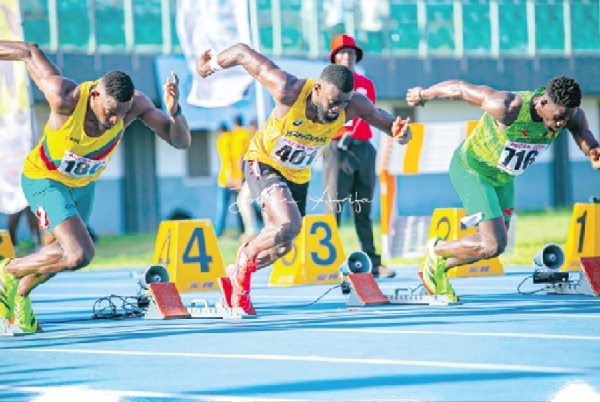
So the medals have all been handed out. The flags have been lowered. The speeches have been made. And Ghana’s moment in the continental athletics spotlight is officially over.
The 24th African Athletics Championships closed yesterday, May 17, at the University of Ghana Stadium, bringing down the curtain on eight days of competition that will be remembered less for the times on the clock and more for the troubles off the track.
Now that the last athlete has departed and the last journalist has filed their story, we can speak plainly: this championship did not fail because of bad luck or insufficient funds.
It failed because successive governments have abandoned every sporting discipline that is not the Black Stars, and because we have normalised poor planning as a national lifestyle.
The result was an embarrassment that played out not in whispers but in headlines across the continent.
For decades, Ghana’s sports policy has been a one-man band: football, and only football.
The Black Stars have enjoyed chartered flights, luxury camping in Turkey or Qatar, appearance bonuses paid in foreign currency, and the personal attention of presidents.
Meanwhile, athletics – the very foundation of the Olympic movement – has been left to beg.
Federation offices under-resourced. Local competitions non-existent. Talent untapped. And then we wonder why, when called upon to host Africa’s premier track and field event, we crumbled.
The evidence was overwhelming. During the championships, athletes complained of long waiting hours for transport between hotels and venues.
Journalists decried accreditation chaos, Internet blackouts, and woeful workspace arrangements.
A South African athlete, Aiden Smith, went public with allegations of food rationing at hostel accommodations – a claim that Deputy Director-General of the National Sports Authority, Veronica Commey, called “surprising” while insisting that food was plentiful.
But the fact that such a claim could be made, and widely believed, tells its own story.
It tells of a country that has lost the trust of its guests. It tells of a nation that confuses busyness with efficiency, and last-minute improvisation with competence.
Destiny
Let us be clear: Ghana is not a poor country. We are a poorly organised country. There is a difference. Poverty does not explain why accreditation processing had not been finalised weeks before athletes arrived.
Poverty does not explain why schedules kept changing without communication. Poverty does not explain why media workspace arrangements – a basic requirement for any international event – appeared to be an afterthought.
What explains these things is a deep cultural habit of postponement, reaction, and the dangerous belief that “we will manage” is an acceptable substitute for planning.
The African Athletics Championships did not expose a lack of money. They exposed a lack of method.
And that lack of method is the same dysfunction Ghanaians endure daily: at the passport office, at the port, at the airport, in the classroom. The only difference is that this time, the whole continent was watching.
Now that the closing ceremony is behind us, we face a choice. We can forget, as we always do, until the next international embarrassment. Or we can finally confront the truth.
Solution
First, we need a national sports policy that ties state funding to structural accountability. Any federation that cannot present a verified calendar of local competitions, a documented athlete welfare protocol, and a functioning media liaison plan should not receive its full allocation.
Second, we must establish a standalone Major Events Authority – independent of the Sports Ministry and the National Sports Authority – with a mandate to plan international tournaments at least 18 months in advance, and with performance contracts that allow for dismissal when standards are not met.
Third, we must decouple the privileges of the Black Stars from the poverty of every other sport. Football earns its own television revenue – let it keep it – but state subvention must be distributed equitably across all disciplines.
Fourth, and most urgently, we need a national conversation about order, accountability and time. The way we run sports is the way we run the country.
Until we accept that disorganisation is not a charming quirk but a costly crisis, we will continue to embarrass ourselves on every continental stage that is not a football pitch.
The African Championships have come and gone. The athletes have returned home with medals – and with stories. Some of those stories are inspiring. Too many are cautionary tales about Ghana.
If the only lesson we take from these past eight days is that we should try harder next time, we will fail again. We do not need to try harder.
We need to plan properly. That is a very different thing. And until we learn it, the only thing Ghana will host successfully is regret.