
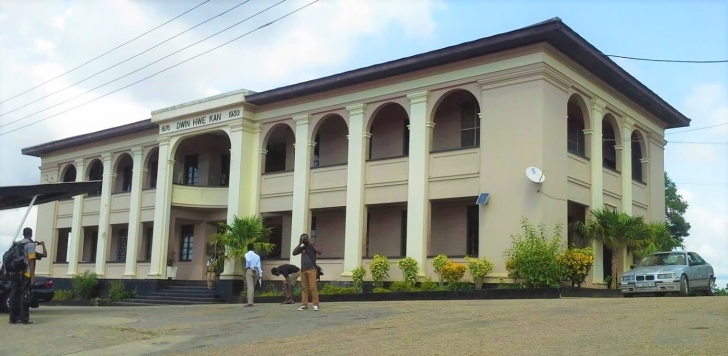
There are certain memories that never fade—no matter how many years pass, they linger like a familiar scent. For me, life at Mfantsipim School is one of those enduring fragrances, a bouquet made up not only of discipline and structure, but also of quiet rebellion, youthful curiosity, and the irresistible pull of the outside world.
Mfantsipim was built on order. Everything had its place, and every boy was expected to fall in line. Meals were no exception. You either ate in the dining hall or depended on what your chop box could provide, and like all school gatherings, attendance was compulsory. Life was simple, predictable, and controlled. But boys, as boys always will, found ways to stretch the boundaries of that order.
Within the school itself, a quiet economy thrived. In the mornings, while some made their way dutifully to the dining hall, others slipped quietly toward the day boys’ market. There, they enjoyed Auntie Mary’s balls or Marie’s Abrewa, often laced with “contains.” The wives of other staff members were not left out of this thriving economy—food and snacks were also sold from their bungalows.
Breakfast in the dining hall often felt like an afterthought, with only a few tables occupied. The real action, it seemed, was happening outside the dining hall—at the day boys’ market. A few boys, like Samo Peteku and Samo Anomaa, had a field day in the dining hall. SAMO was one of the regular breakfast meals served in the dining hall.
Mrs. Yamoah, Mrs. Quansah, Mrs. Dadson, Mrs. Eshun, and Mrs. Hackman each had their specialties and loyal patrons. Mrs. Yamoah was known for her eggy brodos, Mrs. Quansah for her buff and Portello, Mrs. Dadson for her bread, and Mrs. Eshun for her meat pie. In Form One, however, it was Mrs. Hackman who captured our imagination with her pork soup. We even nicknamed a senior “Ghanney Pork” because of his love for it. The name stuck as did the taste.
Under Freeman/Aggrey, life had its own rhythm. Baanua, Esi Buff, and Kate sold rice, buff, and poki to eager boys who had “dough.” These were not just food vendors; they were part of an ecosystem—a parallel world that existed at the periphery of the rigid structure of school life.
Breaking bounds was never just about hunger—it was a statement. A declaration of boldness. A way to prove you were not confined by the invisible lines drawn around you.
Across what we called the Berlin Wall stood Yorks, a business that carried its own quiet reputation. Daavi ran a trade that was less about money and more about ingenuity. She practiced a kind of barter system that would have made our history teachers proud—Lux and Sunlight soaps exchanged for food; necessity traded for desire. In her strong Ewe accent, she would ask, “Ebetor blodiaa? Gali ka huu?” And then there was Besi, her daughter—dark, striking, and impossible to ignore. She became part of the lore surrounding that place, another reason boys found their way there.
Further along, at the school junction and kenkey down; Anyen’s kenkey drew its own loyal following. Around the same area were Pitmans and CSI Vocational Schools, whose girls added another layer of temptation and intrigue, fuelling boys’ desire to break bounds.
For those who ventured even farther, Kotokuraba offered more: a palm wine joint near the fire service and the ever-popular Jet Waakye. AKAGEES were also part of that world, representing yet another dimension of youthful exploration. Further down stood Dans Paradise (Dans P) and The Same People on one side of town, while Friends and Solace stood on the opposite side. These were legendary spots in their own right—more than destinations, they were experiences, each with its own story, flavour, and sense of freedom.
Of course, these adventures were not without consequences. Many boys were beaten or chased away by local indigenes for going after their girls. The popular AKAGEES who seemed to control the scene in our time included Wodooso, Columbus, and Akosua Nyamekye. Hmm! AKAGEES! WONSA DA!
And then there was GBC—a place that took on a different kind of reputation altogether. It became one of the hideouts for boys’ nocturnal activities, a quiet refuge where the night offered cover for things that could never happen in daylight. Like many of these places, it existed more in whispers than in open conversation, yet its presence was well known among those who paid attention.
I heard about them all. For seven years on the hill, I stayed within bounds. I never slipped out to Dan P. In fact, I do not even know exactly where it is located. My only taste of Jet Waakye came second-hand, from boys who broke bounds and smuggled it back to the dormitories.
I remember one moment vividly. The head boy for 93/94, Serebuoh, had seized five packs of Jet Waakye from some boys. But one pack held all the meat—and by sheer luck, that was the one that came into my possession.
Not long after, Danny Sey walked into the prefect’s room, pleading with me to intervene on his behalf and help him retrieve his confiscated waakye. I was then the Bartels/Sneath middle floor house prefect. Meanwhile, my roommates and I were already deep into enjoying it. The irony was too much—we burst into laughter, the kind that comes when guilt and good fortune collide. It was one of those unforgettable boarding school moments.
I never joined the quiet exodus of boys sneaking into town in search of something more than what was provided. And yet, I was not untouched by it all. Because at Mfantsipim, even the things you did not do became part of your experience. The stories, the whispers, the reputations of these joints—they travelled. They filled the dormitories, shaped conversations, and defined, in subtle ways, what it meant to belong.
Looking back, I realize that the true bouquet of those years was not just in the places themselves, but in what they represented: the tension between discipline and desire, between conformity and individuality, between the life we were given and the life we quietly reached for.
Some boys tasted that freedom directly. Others, like me, only observed it from a distance. But in the end, we all carry its memory.
As Mfantsipim School marks its 150th anniversary, these memories take on a deeper meaning.
What we lived on the hill was more than routine, more than discipline, more even than mischief. It was formation—the quiet shaping of boys into men through structure, through temptation, and through choices made and unmade.
The dining hall and the day boys’ market, the joints and the boundaries, the laughter and the near-misses; all of it was part of a larger design. A system that did not just educate the mind, but tested character. Some broke bounds. Some stayed within. But all of us learned. And that is the enduring genius of Mfantsipim.
150 years on, the hill still stands. New boys walk the same paths. New stories are being written in dormitories, in classrooms, and yes—even beyond the walls. The names may change. The joints may evolve. But the essence remains.
The question now is not just what Mfantsipim has been. It is what it must become.
As members of MOBA, as custodians of this legacy, we are called to more than remembrance—we are called to stewardship. The next 150 years will not build themselves. They will depend on what we choose to preserve, what we choose to improve, and what we choose to pass on.
Will the discipline remain firm but meaningful?
Will the structures continue to shape, not stifle?
Will the boys of tomorrow still find both guidance and the space to discover themselves?
These are our questions now. Because the true bouquet of Mfantsipim is not just in its past—it is in its continuity.
We inherited the hill.
We lived it.
Now we must sustain it.
So that 150 years from now, another boy—now a man—will sit somewhere, reflecting, and simply say—There are certain memories that never fade.
DWEN HWE KAN!
- Read also
- Mfantsipim School @ 150 and Creech’s Mfantsipim Diaries: My First Shock
- Mfantsipim School @ 150 and Creech’s Mfantsipim Diaries: My second shock
- Mfantsipim School @ 150 and Creech’s Mfantsipim Diaries: Shock Number Three
- Creech’s Mfantsipim Diaries. My final shock
The writer is Philip Creech-Jones of MOBA 1992 (Mfantsipim Old Boys Association).
