
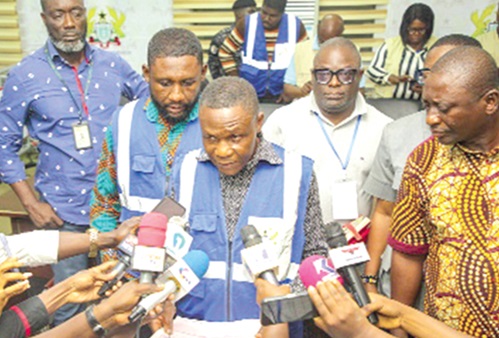
Over the weekend, the Ablekuma North Constituency literally hijacked the news headlines as the nation’s attention was directed at the violence that erupted in the constituency during the rerun of 19 polling stations following some challenges in the aftermath of the December 7 election.
I am sure I am not alone in being unable to watch repeatedly the video scenes showing the brutal assault on former NPP MP, Mavis Hawa Koomson, and NPP Deputy National Organiser, Nana Lloyd, by a group of thugs. In both cases, the attacks could have easily led to the victims’ deaths.
There are reports of other individuals being assaulted.
Quasi bye-election
Whilst Saturday’s event was not a bye-election, it had all its hallmarks - focused national attention, party heavyweights and a sea of campaigners from both sides descending heavily on the constituency and the prospect of it being seen as a verdict of the performance of the government in power. All these combine to generate heat and tension.
Of course, given that these violent incidents stemmed from a highly charged electoral process involving the two main parties in the country, it was inevitable that some voices would consequently be registered with varying intensity on the ‘outrage meter’ in the public square.
Whilst some in the NPP promised retribution one day, others in the NDC effectively shrugged and invoked the violence during the Ayawaso West bye-election in 2019, citing the past ‘sins’ of Ms Koomson when she was in government.
On February 5, 2019, writing on this page about the events of that bye-election that took place on January 31 that year, I noted as follows;
‘The recorded assault of a Member of Parliament and another person believed to be his aide, by way of slaps, during last week’s parliamentary bye-elections in the Ayawaso West Wuogon Constituency would trouble any right-thinking member of society and they are utterly despicable. No human being deserves this.
Violence is never the way to resolve differences and in fact, they do escalates them, because the victim or his associates are likely to ignore the biblical exhortation in Romans 12:19 (‘Dearly beloved, avenge not yourselves…vengeance is mine, I will repay, saith the Lord’).
My position still holds firmly in the aftermath of the violence of last Saturday.
Invariably, when bouts of election-related violence occur, elements of incumbent parties tend to cite previous electoral violence when they were in opposition and some of their party folks were assaulted.
In the process, they effectively treat the immediate past government’s ‘misdeeds’ as the ‘Ground Zero’ of sorts of electoral violence, ignoring what took place much earlier on their watch.
This ‘you-did-it-first’ finger-pointing, combined with promises of retribution, almost invariably carried out when the tables turn, tends to perpetuate this cyclical syndrome in the pathetic race to the bottom of the barrel.
History or political violence
Who is supposed to effectively pull the brakes and turn the other cheek?
Unfortunately, apart from the violence at the Ayawaso West Wuogon, Atiwa, Talensi, and Chereponi bye-elections of the Fourth Republic, as well as general election-related violence, we have a history of political violence dating back to the run-up to independence, with pro-CPP and pro-NLM groups in the fifties (Action Troopers versus Action Groupers).
This came to a head in October 1955 when a quarrel between the CPP and NLM groups in Kumasi’s Ashanti New Town led to the stabbing to death of E.Y Baffoe of the NLM by K.A Twumasi Ankrah, the Ashanti Regional Propaganda Secretary of the CPP.
Further, in the matter of the Union Government, which the Acheampong regime tried to smuggle into the country in the late 70s, there were loud protests that the government attempted to curb by sheer intimidation and violence, especially in the aftermath of the 1978 referendum that was rigged.
The Rawlings revolution also devised its methods for those who stood up against the military regime of the day, including student leaders and union activists protesting against the biting effects of IMF and World Bank-inspired economic reforms.
In all these, raw state power, combined with a determination to teach opponents a lesson and discipline them, whether in retribution for past political infractions when those in charge were on the other side of the bank, seems to be key in recycling political violence.
The impunity is heightened when pro-government activists feel emboldened to behave in a particular manner because they believe they are politically insured.
Real danger
The real danger is that we end up inching towards the precipice, one election cycle at a time. Already, there are concerns that the upcoming bye-election at Akwatia could be a major flashpoint.
When will the two parties stop exchanging blame whilst the rest of the nation looks on? When exactly do we pull the brakes on this slow-moving train that seems to be going round in circles? How do we short-circuit it all?
We love to tout ourselves as a peace-loving country, complete with a publicly-funded Peace Council to, among others, ‘build sustainable peace in the country’ and where ‘Peace’ is a common girls’ name in certain parts.
But peace is more than the absence of war.
We cannot take it for granted and must work assiduously to preserve it. Hoping is not quite enough.
Citizens of other countries that exploded in civil strife are not innately violent and must have at some point prided themselves as peaceful people.
It only takes a small spark.
Citizens must not feel on edge just because a general or bye-election is imminent.
Whatever our political differences, they cannot be resolved through puffy lips, swollen eyes, broken teeth or realigned jawlines, delivered via hefty punches or flying kicks.
Rodney Nkrumah-Boateng.
E-mail:
