
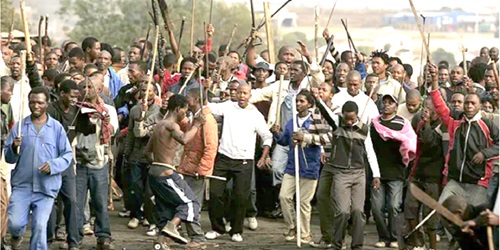
Citizens from several African countries have been harassed, expelled or killed by South Africans in periodic bouts of xenophobic violence.
The first incidents occurred in the 1994–2000 immediate post-apartheid period, with attacks in Alexandra Township (Johannesburg) and Cape Town, where Africans were killed or maimed for being “illegal” or for allegedly dispossessing South Africans of economic opportunities.
This violence persisted in 2008, beginning again in Alexandra Township when it was documented that 60 deaths occurred, tens of thousands were displaced, and their properties and shops were razed to the ground.
Over recent years, a pattern has been established that requires a forceful government response.
The victims have been mostly Zimbabweans, Mozambicans, Congolese and Nigerians.
Xenowatch cites 669 deaths linked to xenophobic violence between 1994 and March 2024.
It also indicates that over 5,300 shops were looted and 127,572 people displaced, while recognising that these could be an underestimation.
Comparable figures for prosecution and conviction are hard to find.
Conservatively, it is estimated that 10 per cent of perpetrators may have been prosecuted, an unacceptably paltry figure for any administration bent on stemming xenophobic violence.
Even more disturbingly, human rights organisations point to the lack of hate-crime statutes and the casual way authorities treat xenophobic violence.
Violence can never be justified, least of all when other Africans are scapegoated for ineffective government action in redressing the ills of apartheid.
The lack of opportunities for South Africans and the protection of other Africans in South Africa are squarely the responsibility of the government and should be pursued with equal fervour.
Inaction does not merely fail victims; it can inadvertently encourage and spur on violence.
First, government response. From the recorded incidents of attacks on non–South African Africans, data on prosecutions is hard to find, and with widespread belief that prosecutions are low, the deterrent effect is plainly diluted.
The lack of enforcement of laws against such criminal activities, including the heinous acts of murder and arson, amounts to tacit encouragement of violence and has led to calls from the African Commission on Human and Peoples’ Rights for action.
Whenever criminals are not held responsible, unchecked in their evil shenanigans, they become recidivists and inspire other would-be criminals.
Impunity is a travesty not only of justice, but of the rights of other Africans in South Africa to live a peaceful life.
The issues of fading history and education also come to the fore. South Africa should be one country that continuously informs and sensitises its citizens to the role of other African countries in their struggle against apartheid and for liberation.
For frontline states, including Zimbabwe and Mozambique, which provided rear-guard and transit points for those fighting apartheid—and for countries like Tanzania, Guinea, and Ghana, which, in various ways, supported the struggle morally by granting abode, training and facilitating services.
This is the history that has to be taught: Africa’s interdependence, the linkages in our fates, and hence the sacrifices other countries made to support the overthrow of the brutal apartheid regime.
When citizens are well informed and sensitised to the sacrifices made for them and their independence, they will be more amenable to curbing the excesses.
While not preaching the placement of banners in all South African streets, or the constant running of messages on all television screens, we Africans always run the risk of forgetting our history, our interdependence and holding on to manufactured truths that become the clarion call for violence.
Other Africans are not the cause of the problems in South Africa, be it unemployment or dispossession; it is the apartheid regime and its consequences that have not been dealt with systematically.
Academic theories will explain this black-on-black violence in several ways. Proponents of social disorganisation will point to weaknesses in formal and informal structures.
Attacking other people who happen to be African is thus an emanation of weak institutional barriers to violence in South Africa.
The killing of Africans is facilitated by proximity and the unleashing of unchecked anger. Others will justify these crimes by relative deprivation.
Most Africans come to South Africa as migrants and, like migrants anywhere, work hard in any available jobs to survive. They are cut off from the social networks that would have supported them back home.
Through these efforts, they may show apparent well-being compared to their neighbours, who may blame them for taking their jobs and hence unleash violence on them.
It will be interesting to find documentation on what and how many jobs other Africans have taken from South Africans, with the willingness, capacity and competencies for those jobs.
Whatever theory one may want to use, it is obvious that the lack of clear community, provincial and national leadership on xenophobia is why this repeated violence festers. Impunity has gained ground as institutional deterrents have faltered.
Violence has carried the day as history, and Africa’s sacrifice for South Africans has been occulted.
It is of utmost importance that the authorities in the various jurisdictions play their role and enforce the law; otherwise, this xenophobia will continue, deepen and enfeeble African unity.
Joblessness, apartheid remnants and poverty are well documented in South Africa, especially among blacks.
These realities, while denigrating the survival of black South Africans, should not be used as justifications for violence against neighbours.
The killing and maiming of other Africans in these bouts of xenophobic fervour are crimes of opportunity and proximity.
Other Africans are bearing the brunt of the lack of leadership in South Africa.
This diminishes the role and place of South Africa on the continent and internationally.
The only way to stem these episodes of violence is to apply the law ruthlessly, prosecute perpetrators, and enforce real deterrence.
The ball is in the camp of community, province and national leaders, and it must be played with urgency.
The African Union’s vision is one of people and the freedom to move around; this should be upheld by all countries.
Anthony Ohemeng-Boamah is a development expert.
He can be reached at
