
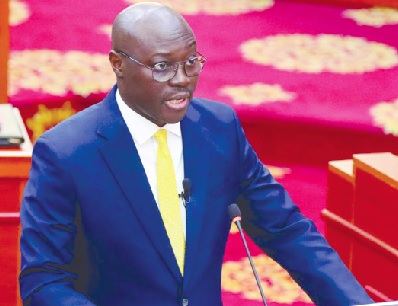
The Minister of Finance, Dr Cassiel Ato Forson, will not ask for any supplementary estimates as he presents the Mid-Year Budget Review to Parliament this afternoon to provide a comprehensive update on the implementation of economic policies and programmes.
But aside from expenditure and revenue performances, he is also expected to update Parliament and the nation about the numerous savings the country is making and the systems put in place to honour its obligations under the Domestic Debt Exchange Programme (DDEP) as well as Eurobonds, dollar-denominated external bonds.
He will also provide updates on flagship programmes and projects, and announce sweeping reforms in Value Added Tax (VAT), procurement, new funding approaches and efforts to plug revenue loopholes.
Interacting with a cross-section of journalists ahead of today’s presentation, Dr Forson said the review would also contain a full disclosure on the 36-month non-financing Policy Coordination Instrument (PCI), the new arrangement with the
International Monetary Fund (IMF), with the 26 targeted reforms, interventions, timelines and their expected outcomes.
The $300 million World Bank loan to eliminate the double track would also feature prominently in the budget review.
That would include the $60 million to be dedicated to the construction of 16 schools across four districts which have no secondary schools, and densely populated urban areas, including Asawase in Kumasi in the Ashanti Region, and Nima, Ashaiman and Madina, all in the Greater Accra Region.
The government will also dedicate $60 million to the supply of textbooks for all senior high school students, among others.
Accra-Kumasi Expressway
Dr Forson said the government had to resort to the 48 Engineers Regiment of the Ghana Armed Forces (GAF) to clear the pathway or the Accra-Kumasi Expressway and determine compensation for affected property owners.
He commended the regiment for its professionalism and hard work, which had led to the clearance of 70 per cent of the predominantly virgin road network.
So far, the regiment’s engineering and surveying work had yielded significant reduction in travel distance between the country’s two major cities, from about 250 kilometres to 176km, the Finance Minister pointed out.
He would also inform Parliament that the engineering design had been completed, the road path clearance expected to end by September this year, while procurement and other approvals were expected to be secured by the end of the year so that actual construction work could begin by early next year.
So far, the government has deposited the cedi equivalent of $1.7 billion in an escrow account for the project, with a target of ramping up to $3 billion by the end of the year.
New agric roads
The minister said among the updates to be provided was the construction of a 1,050 kilometres of agricultural roads to facilitate the movement of produce from farms to markets.
He said the project, which would be cited across the country, would replace the previous cocoa roads and open up the country for the easy transfer to produce from farming hubs to markets, a deficiency which contributes to food inflation in the country.
Towards the execution of that project, the government had secured $500 million support from the World Bank, with a $23 million counterpart funding, Dr Forson disclosed, and insisted that the government was determined to direct 98 per cent of the amount into real and direct construction, a marked departure from when such facilities were laden with unnecessary lines such as capacity building, the procurement of vehicles.
The Finance Minister would also provide update on the 1,200 megawatts (MW) thermal power plant planned.
So far, the Ghana Thermal Power Ltd, the special purpose vehicle (SPV) established to implement a thermal power project, had on its own balance sheet ordered the turbines required for the first phase of the initiative directly from the original equipment manufacturer, General Electric (GE), saving the country 35 per cent of the cost of construction.
The minister explained that the first phase of 600MW would come on stream by the second quarter of 2028, with the remaining half expected to be ready by 2029, with the entire project costing about $1 billion.
The plan is to replace the Karpowership, when its contract with the country expired in few years, adding that the completion of plan was expected to reduce electricity tariff by 10 per cent.
Savings
Dr Forson said the new customs classification and valuation system, the Publican Trade Solution, had so far helped the state to mobilise $300 million more revenue after three months of rollout at the ports of entry in March this year.
He said the additional revenues were not as a result of additional trade volumes because that had not changed much.
However, Dr Forson said, there were other customs regimes that needed to be looked at again to close identified loopholes that some port users were taking advantage of.
Publican, an artificial intelligence (AI)-based software, helps customs officers to determine the real value of imported goods declared into the customs system.
It flags undervalued import declarations which enables the Customs Division of the Ghana Revenue Authority to impose the right import duties.
Dr Forson added that the excellent economic performance and the stable exchange rate had led to more savings, which he enumerated to include a total of GH¢15 billion savings on interests on debts.
Reforms - VAT
The Finance Minister is expected to announce reforms in the country public sector procurement to tighten and make it more stringent.
For instance, there would be tighter measures on restrictive tendering, with emphasis shifted on to competitive tendering.
There would also be the reduction in the tendering processes, with the aim of lessening the period for international tendering to 16 weeks, significantly down from 77 weeks it currently takes to complete.
To help close the 60 per cent VAT performance shortfall, the government would announce measures to mandate the use of Point-of-Sale (PoS) devices in all shops registered to collect VAT so as to ensure that revenue collected are remitted to the GRA.
Also, the Finance Minister would announce a review of excise duties, which is currently levied on alcoholic and sugar sweetened beverages, not to raise more revenue but to make them efficient and encourage local productivity.
The measure would include its abolition on fruit juices produced in the country to encourage their uptake.
Dr Forson said the threshold for sliding scale excise duty on the use of local raw materials would be adjusted to incentivise breweries to use more local raw materials — maize grits and cassava — in the production of beer and stouts.
