
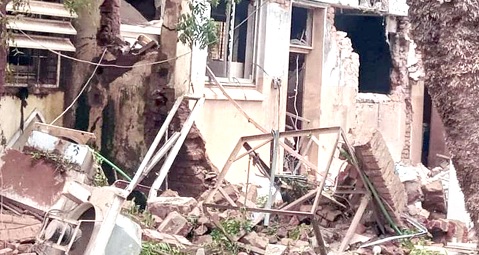
Sudan’s war has entered its fourth year, but there is little indication the conflict will end any time soon, as the army and the paramilitary Rapid Support Forces (RSF) are locked in battle for control of the North African nation.
Sudan’s civil war erupted on April 15, 2023, leading to what is considered the world's worst humanitarian crisis and three years on, the conflict has seen human suffering on a huge scale, with no clear end in sight.
Thousands of civilians have been killed, with 65 per cent of the population in need of food, water, shelter and medicine, while millions more have been forced from their homes, seeking safety in neighbouring countries, including South Sudan, Egypt, Chad, and Ethiopia. World diplomacy has had little success in bringing the war to an end.
Foreign governments
Three years into this crisis, the needs continue to grow, especially as support from foreign governments wanes and global attention shifts to other conflicts.
Sudan must not be forgotten.
The resilience of refugees and other forcibly displaced people endures, and so too does the responsibility to remain present to them.
As the conflict enters its fourth year, the fighting has led to a de facto partition between territory held by the army and the paramilitaries.
On the ground, the conflict has created a clear division between eastern and western Sudan, with the Sudanese army controlling the northern, central and eastern states, as well as the capital.
Meanwhile, the RSF controls Darfur and large parts of the three Kordofan states, and has also opened a new front in the Blue Nile region along the border with Ethiopia.
Diplomatic efforts to end the war led by the US have failed, with both sides given support by regional powers that enable them to keep fighting.
Khartoum recaptured
On May 20 of last year, the Sudanese army recaptured Khartoum State from the RSF forces after more than two years of fighting, marking one of the biggest military developments of the year.
Life has gradually returned to a fragile state of near-normalcy in the capital, Khartoum, and central regions after the army regained control of the regions.
However, this relative stability has been accompanied by a sense of unsettling uncertainty, as economic and living conditions continue to deteriorate, the military deadlock persists in the Kordofan region, and the humanitarian crisis in Darfur has worsened.
In Khartoum, prices of fuel, bread, goods and services have risen sharply in recent days. This has coincided with the depreciation of the Sudanese pound, with the US dollar now worth about 600 pounds.
Security improvements
Despite some improvements in security in certain areas, the International Organisation for Migration reports that about 3.99 million people had returned to their homes as of April, mainly to Khartoum and Gezira.
Out of these, 83 per cent are internally displaced people and 17 per cent returned from abroad.
More than 13 million people remain displaced or refugees, including about nine million within the country.
arlier, on January 11, 2025, the army also retook Wad Madani, the capital of Gezira State.
It then expanded its advances by pushing RSF forces out of northern White Nile State, breaking the siege on el-Obeid in North Kordofan in February 2025, and regaining Kadugli and Dilling in South Kordofan by last February.
The army retook Bara, the second-largest city in North Kordofan, in March.
Gains RSF made
Despite the army’s achievements, the RSF made significant military progress as well. Most notable is their capture of el-Fasher, the capital of North Darfur, on October 26 of last year after a two-year siege.
This allowed it to consolidate control over most of the region, except for three northern regions still held by the army and joint forces, as well as areas controlled by the Sudan Liberation Movement (SLM) armed group led by Abdel Wahid al-Nur.
Emboldened by the fall of el-Fasher, the RSF advanced towards Babnusa in West Kordofan later in December 2025.
This came shortly before the army withdrew from the Heglig oil region, the country’s largest oilfield in West Kordofan, resulting in the state falling under RSF control.
RSF forces remain present in scattered areas of North Kordofan, including Umm Qarfah, Jabra al-Sheikh, Umm Badr, Hamra al-Sheikh, and Sodari.
They are also active in parts of South Kordofan, particularly in Al Quoz, Al-Hamadi and Al Dibibat.
Spread of conflict
By the end of the third year, the conflict had spread to eastern Sudan. And with the joint force of the RSF and SPLM-North, the city of Kurmuk in Blue Nile State was captured in March of last year.
This prompted the Sudanese government to accuse Ethiopia of providing military and logistical support – an accusation they have since denied.
The nature of the war has also evolved in recent months.
The RSF has increasingly been relying on drones to strike targets in central and northern Sudan.
In response, the army has acquired new drones, enabling it to target supply lines, eliminate several RSF leaders and destroy their military equipment.
On the humanitarian front, the war has reached catastrophic levels.
A joint report by the International Committee of the Red Cross, UNICEF, and Intersos found that about 14 million people have been displaced over three years.
Simultaneously, 26 million people face acute food insecurity, while 33.7 million require humanitarian assistance, including 7.4 million people internally displaced.
Quadrilateral Initiative
The Quadrilateral Initiative – the United States, Saudi Arabia, Egypt and the United Arab Emirates – has failed to achieve a breakthrough despite presenting a peace plan in September.
Similarly, the Sudanese government’s proposal in February 2025, later presented again to the United Nations Security Council in December, did not yield tangible progress.
The humanitarian toll continues to rise beyond Sudan’s borders.
Neighbouring Chad alone hosts over 900,000 refugees, with hundreds more crossing daily.
Overstretched camps and limited resources are leaving many without adequate shelter, food, or medical care.
Back in Sudan, only 63 per cent of health facilities remain operational, according to the World Health Organisation, as disease outbreaks such as cholera spread rapidly.
Attacks on healthcare workers and infrastructure have further crippled the system.
Despite the scale of the crisis, international engagement remains limited.
A conference hosted in Berlin aimed at mobilising humanitarian support and pushing for a ceasefire has already drawn criticism from Sudan’s government, which described it as external interference.
