

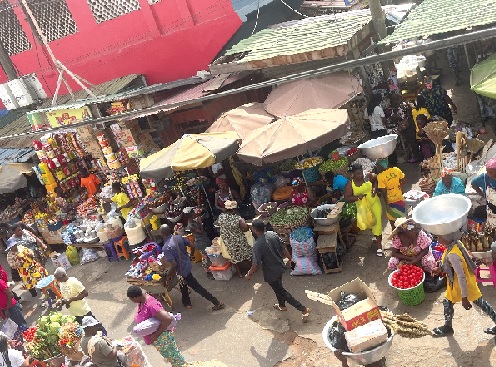
Madina Market grapples with congestion, after decades of growth
FOR more than four decades, the bustling Madina Market has been a lifeline for traders and consumers , evolving from a modest trading post into one of Accra’s busy commercial centres.
With this growth has come mounting challenges such as congestion, higher prices due to constant increases by suppliers and fierce competition among traders, leaving long-time traders like Adwoa Krankyewaa reflecting on how the market has changed and what it now takes to survive within it.
The market serves nearby communities including Adenta, Legon and Oyarifa, with food supplies arriving daily from farming areas such as Sefwi and Asante Akyem in the Ashanti Region.
In an interview with The Mirror at the market last Wednesday,Miss Krankyewaa recalled that the market used to be smaller, quieter , easier to navigate and the traders knew eachother.
Miss Krankyewaa who has been selling plantain and other food items at the market since 1986, said the once small and orderly marketplace had become a crowded and chaotic environment, making business more challenging for traders.
She explained that limited space had become a major concern, forcing many traders to operate without regard to regulations.
She said some of the traders had set up stalls along roads, under sheds, on overhead structures and even encroached on the highway.
The situation, she added, became more severe on Wednesdays and Saturdays which are the market’s busiest days, a development this reporter also observed during a recent visit.
Four decades of transformation
Reflecting on her journey, Miss Krankyewaa said she initially sold tomatoes and cassava before switching to plantain, which she found more stable.
She identified 1999 as a turning point when the market expanded significantly, attracting more traders and increasing competition.
“Transportation fares started going up, and weather changes began affecting farm produce. Farmers complained about poor conditions, which made goods more expensive. This eventually affected us, and we had to increase our prices,” she explained.
Over the years, she said, many traders had come and gone, noting that those who succeeded were often those who built trust with customers and maintained honesty in their dealings.
Struggles of younger traders
For younger traders such as 23-year-old Ayisha Mohammed, who sells garlic on the Madina Zongo overhead, the lack of a permanent selling space remained a daily struggle.
She said she had to constantly watch out for city authorities who occasionally carried out decongestion exercises, forcing traders to flee.
“I took over from my mother when I was 15. Now, I mostly work on busy days, but there’s no guarantee I can stay in one place,” she said.
“You set up and then they chase you away, and you have to find another place, losing customers for the day. Prices have also gone up, so sometimes sales are not even up to GH₵100 a day,” she added.
Bustling commercial hub
On the day of the visit, trading activities begun as early as 5 a.m., with the market already bustling with activity. By mid-morning, movement through the market remained slow due to narrow pathways and heavy human traffic.
A wide variety of goods were on display including meat, vegetables, fruits, cosmetics, mobile phones and clothing. Thrift items were hung on colourful umbrellas, spread on the ground and displayed along the edges of the road.
Traders called out prices in Twi, Ga, Hausa and English, while buyers moved from stall to stall comparing prices. Music from nearby shops added to the noise in the environment.
Head porters, popularly known as kayayei, were also seen moving through the market, offering to carry goods for shoppers.
Market leadership and welfare
To maintain order and support traders, the market operates under a leadership structure headed by two queenmothers, Madam Mercy Yeboah, and Madam Eunice Quao.
Although they were unavailable for comment, Madam Krankyewaa explained that the queenmothers played key roles in resolving disputes, representing traders before the La Nkwantanang Madina Municipal Assembly, and supporting welfare initiatives for traders who depended on the market for their livelihoods.
