

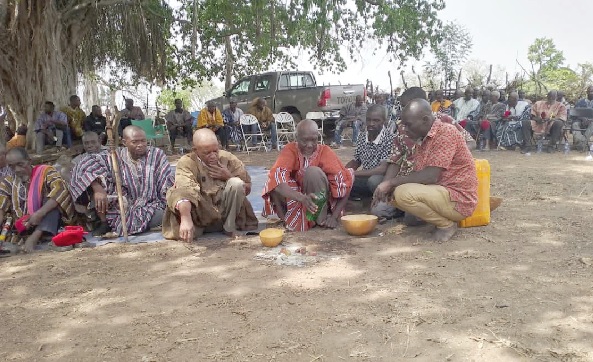
Vagla community performs sacred Chalpaë ritual
Vagla land priests gathered in the indigenous community of Dagbigu in the Savannah Region, last Friday, to perform the sacred Chalpaë bloodpicking ritual, a ceremony aimed at restoring harmony between the living and ancestral spirits. This followed recent community conflicts.
The ritual, conducted by Vagla Hɛuhina (land priests) of the Vagla Traditional Authority, was a significant cultural event for communities along the Black Volta in the Sawla-Tuna-Kalba and Bole districts. Dagbigu, the birthplace of Gbiniyiri, Janivuri, and other settlements in the region, served as the site of the cleansing.
According to Vagla tradition, the Chalpaë ceremony neutralises bloodshed through spiritual energies that prevent reprisals and redirect attacks. When communities experience famine, conflicts, barrenness, sickness or plague, it is believed that ancestral balance has been disrupted.
"The cleansing ceremonies marked the end of confusion and the start of a new dawn," the participants, who cautioned all parties to respect tradition to avoid divine retribution, said.
The recent conflict in Gbinyiri was interpreted by Vagla elders as tension between the ancestral world and the living, requiring spiritual intervention through traditional rites.
In Vagla cosmology, life is symbolised as an egg – fragile and sacred. The ritual employs day-old chicks that have not yet consumed food or water as offerings to appease ancestral spirits.
When more significant atonement is required, mature fowls are used to communicate with foundation gods, including Tuna Gbalbii, Mankuma/Manful Gbolo, Jam Dum, Chorbang Kungi, Soma Yorggor, Sɔgla (Sawla) Hɛu, Belli Woę and Sonyor Kiipo.
The Vagla people share cultural similarities with other Gur linguistic groups, such as the Kasena, Sisaala, Mo (Deg/Bujoma), Chakale, and Tampulma, though some have incorporated Islamic and Catholic practices into their traditions.
Vagla tradition strictly prohibits harming fowls, as these birds produce eggs that symbolise both the creation and conclusion of life.
The community believes that even when settlements become abandoned (Dingela), the land spirits remain active and must be respected.
Following the ritual, community leaders expressed hope for lasting peace and development in the region. They noted with pride that the Vagla people have produced distinguished leaders, including President John Dramani Mahama.
"May the spirits of our lands continue to defeat unfriendly spirits and support growth," attendees concluded at the end of the ceremony.
The Vagla Traditional Authority maintains supreme spiritual power in the region, with foundation gods believed to protect communities from those who disrespect sacred traditions.
The writer is a biometric technologist with the National Identification Authority (NIA) and National Secretary for Vagla Youth Association (VAYA).
