
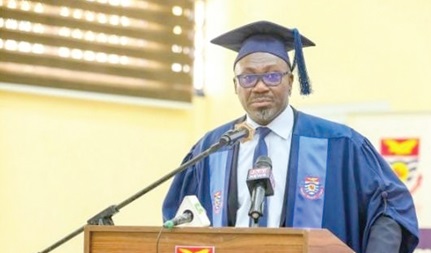
UCC matriculates 24,000 students - Vice-Chancellor warns against indiscipline
The University of Cape Coast (UCC) has matriculated a total of 24,457 students for the 2025/2026 academic year, renewing calls for discipline, academic commitment and responsible conduct on campus.
The acting Vice-Chancellor, Professor Denis Worlanyo Aheto, addressing freshers, cautioned students against acts of indiscipline, particularly inter-hall clashes, stressing that the university would not tolerate behaviour that disrupted academic life.
“This institution exists to help you achieve your dreams, not to send you home,” he warned, adding that any student found engaging in violence or misconduct risked dismissal.
He urged students to familiarise themselves with key university regulations contained in the Students’ Handbook and academic policy documents for undergraduate and postgraduate studies.
The matriculation ceremony was held in a blended format, with some participating virtually and on site.
Discipline
Addressing freshmen, Prof. Aheto urged students to remain focused, disciplined and committed to hard work, stressing that success at UCC demanded sacrifice and perseverance.
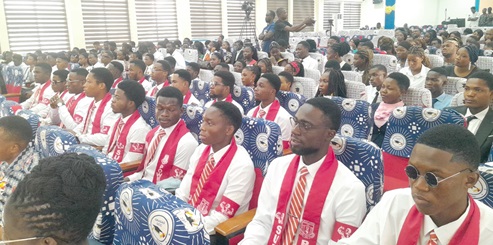
The freshers
“What you become will largely depend on the decisions you make from today,” he said.
Prof. Aheto described UCC as a “university of competitive choice,” assuring students that their decision to study at the institution was well placed.
He noted that UCC had maintained its position as the highest-ranked university in Ghana and West Africa for the fifth consecutive year, according to the 2026 Times Higher Education World University Rankings, and remained among the top 11 universities in Africa.
Academic commitment
The acting Vice-Chancellor emphasised regular lecture attendance, active participation in academic activities and adherence to examination rules, warning against examination malpractice.
He also highlighted the importance of health, safety and sports, encouraging students to make use of campus medical facilities, participate in recreational activities and remain security-conscious, especially at night.
Enrolment figures
Breaking down the statistics, Prof. Aheto said the freshmen comprised 11,178 regular undergraduate students, 7,980 distance education students, 1,296 regular postgraduate students, 3,689 distance postgraduate students and 314 students from satellite campuses.
He added that female students outnumbered males at the undergraduate level, with 10,023 females compared to 9,460 males, a development he described as encouraging for gender balance in higher education.
Accommodation challenge
Prof. Aheto acknowledged persistent accommodation challenges on campus, noting that management was actively pursuing solutions through public-private partnerships.
He revealed that the university's Governing Council had approved guidelines for strategic partnerships and sustainable financing for student housing development, paving the way for engagement with private investors both locally and internationally.
International recognition
Touching on faculty achievements, the acting Vice-Chancellor announced that Professor Robert Peter Binney of the School of Pharmacy and Pharmaceutical Sciences had been elected Chairman of the Africa Regional Committee of the International Brain Research Organisation.
He also disclosed that Professor Ernest Teye of the School of Agriculture had also been selected by the International Atomic Energy Agency as a Chief Scientific Investigator for a coordinated research project.
