
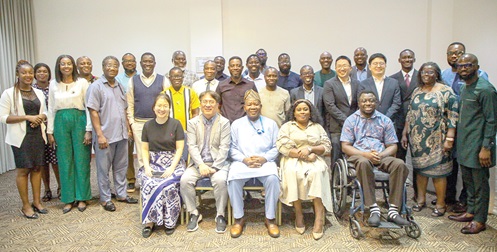
UNESCO, CTVET begin capacity-building workshop
UNESCO, in partnership with the Commission for Technical and Vocational Education and Training (CTVET), has commenced a capacity-building workshop aimed at improving labour market analysis and enhancing national occupational standards in the agriculture sector.
The training seeks to equip stakeholders with tools to identify skills gaps and ensure that TVET delivery responds to industry needs.
The initiative, implemented under the Better Education for Africa’s Rise (BEAR III) project, seeks to ensure that agricultural TVET programmes reflect current industry needs and contribute to Ghana’s broader economic transformation agenda, including the government’s 24-hour economy vision.
Reform
Speaking at the workshop on December 1, the UNESCO Representative to Ghana, Edmond Moukala, explained that the workshop was more than a technical exercise; it is a strategic investment in Ghana’s future workforce.
He said in a world where technology, climate change, and global economic shifts were transforming the nature of work, it was critical that education and training systems remained relevant and responsive.
According to Mr Moukala, agriculture was central to the country’s economy and livelihoods, yet it was evolving rapidly.
Mechanisation, digitalisation, climate-smart practices, and value addition were creating new opportunities and redefining the skills required in the sector.
He emphasised that anticipating those changes and preparing for them was essential for sustaining productivity and ensuring employment opportunities for young people.
Mr Moukala said that the first part of the workshop would focus on labour market analysis.
He said the session would equip participants with tools and methodologies to identify current and emerging skills demands in agriculture.
Understanding the trends, he said, was crucial for designing training programmes that prepare learners for the jobs of tomorrow.
He added that aligning education and training with labour market needs was a central pillar of Ghana’s 24-hour economy programme, as it aimed to create a workforce that was adaptable, skilled, and capable of maintaining productivity beyond traditional working hours.
He said the session would promote collaboration between government, industry, and training institutions, and provide the foundation for competency-based curricula that meet labour market needs.
Modernisation
The National Project Officer for UNESCO’s BEAR III project, Michael Boateng, explained that the project had a dual focus.
The first is to generate reliable labour market data that will inform curriculum development and ensure that TVET programmes address real skill demands, particularly in agriculture; and second, to build the capacity of TVET teachers, whose current teaching methodologies need strengthening to deliver hands-on, industry-relevant training.
Mr Boateng said although the country had 243 public TVET institutions, many lacked the technical capacity to provide demand-driven instruction.
To address that, he said BEAR III was working with some selected institutions, including Asuansi Farm Institute, Adidome Farm Institute, Damongo Agricultural College, Adjura Agricultural College, Dabokpa Technical Institute, the CSIR–Institute of Industrial Research, and the University of Environment and Sustainable Development.
The institutions, he said, represented both pre-tertiary and tertiary levels and were being supported to offer modernised curricula, provide equipment for practical training, and deliver training that meets industry requirements.
