
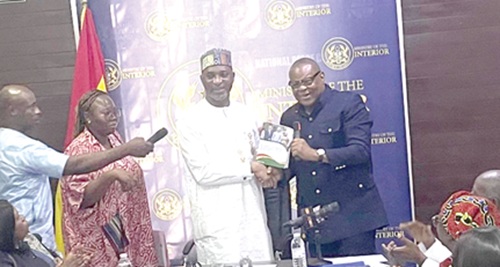
The Gbenyiri Mediation Committee has presented its final report to the Minister for the Interior, Muntaka Mohammed-Mubarak, outlining key outcomes and recommendations aimed at consolidating peace after last year’s deadly clashes in Gbenyiri in the Savannah Region.
The presentation marks a significant milestone in efforts to restore stability to the conflict-hit farming community in the Sawla-Tuna-Kalba District, where a land dispute escalated into widespread violence, leading to loss of lives, destruction of property and the displacement of tens of thousands of residents.
The committee was inaugurated on September 8 last year, with a mandate to facilitate dialogue among feuding factions, support the safe return of internally displaced persons and refugees, assess loss and damage, and propose measures to prevent a recurrence of the violence.
Its work involved consultations with traditional authorities, youth groups, civil society actors and security stakeholders within and outside the Savannah Region.
Presenting the report at the ministry in Accra last Friday, the Chairman of the Committee, Emmanuel Habuka Bombande, mentioned the establishment of a monitoring mechanism to oversee the implementation of agreements under the Gbenyiri Peace Process as a key recommendation.
The committee also proposed that the mechanism should work in partnership with stakeholders, the Regional Security Coordinating Council, civil society organisations and development partners to ensure lasting peace.
It further indicated that although the initial focus was on direct engagement between the Gonja and Lobi-Brifor communities, other groups, such as the Vagla community, should be included in the broader implementation phase to support the peace process.
Mr Bombande also emphasised the need to strengthen state and traditional institutions to make them more preventive-oriented to avert a recurrence of violence in Gbenyiri and other parts of the Savannah Region.
He said the assignment was guided by the minister’s priority to create a secure environment that would foster social cohesion, dialogue and peaceful coexistence, describing the mission as “challenging but necessary”.
The mediator said the committee began by designing a mediation process, following comprehensive consultations, to have an inclusive roadmap that would guide the collective effort in the search for peace.
Through what he termed a systematic and diligent approach, Mr Bombande said the committee sought to build bridges, restore minimum trust among factions and appeal for tolerance and calm to facilitate dialogue among the affected communities.
Mediation process
Mr Bombande said the mediation process included engagements with the Overlord of Gonja, Yagbonwura, chiefs, councils of elders and youth groups.
The committee also met with the Yagbonwura to, among others, solicit his support in fostering dialogue among principal stakeholders in Gonjaland.
The committee also visited Gbenyiri and the surrounding communities affected by the violence and engaged local leaders and youth associations.
According to Mr Bombande, it became clear during the process that some stakeholder groups required internal dialogue to reconcile divergent views before engaging other groups, a step he said proved crucial in rebuilding unity and trust.
“Extensive back-channel communications by key individuals in Gonja land also helped sustain the peace process and create conditions for the gradual return of internally displaced persons and refugees who had fled to Cote d’Ivoire and Burkina Faso,” he said.
Outcomes
Following a series of consultations and bilateral engagements, he said the committee convened a grand dialogue between the Gonja and Lobi-Brifor communities in the Greater Accra Region.
Mr Bombande described the meeting as unprecedented, as it provided a direct platform for discussions on underlying issues to rebuild trust and restore relations between the two communities.
The dialogue resulted in tangible pledges aimed at strengthening peace and deepening relationships between the Gonja and Lobi-Brifor people.
While acknowledging that dialogue was only the first step, Mr Bombande stressed that lasting peace would depend on implementing the agreed outcomes and binding commitments reached during the process.
Minister’s response
After receiving the report, the Minister for the Interior commended the committee for its dedication and gave an assurance that the government would act on the recommendations.
He noted that the committee was established with the primary objective of fostering inter-communal cooperation and peaceful coexistence between the Gonja communities and other affected groups.
“I am aware that the committee has engaged all relevant stakeholders within and outside the Gbenyiri community, and I am assured that this report will serve as a roadmap for rebuilding constructive relationships, tolerance and coexistence,” he said.
“Government is ready to receive this final report and to act with strictness in the implementation of the recommendations,” he assured.
He appealed to development partners and the international community to continue supporting the peace process.
“The weight of getting the report will not be complete without your generous partnership.
We are calling on you to come along with us on the journey to rebuild strong social cohesion in the Gbenyiri community,” Mr Mohammed-Mubarak said.
Background
The Gbenyiri conflict erupted on August 24 last year, over a land dispute.
The clashes led to the death of at least 31 people and displaced about 48,000 residents.
Homes were burnt, farmlands destroyed, and thousands sought refuge in nearby communities and temporary camps set up by the National Disaster Management Organisation (NADMO) in Sawla.
To contain the situation, the Interior Ministry imposed a dusk-to-dawn curfew, banned the carrying of offensive weapons and restricted certain activities in the affected areas.
After spending about a month in camps, displaced residents recently returned to their homes, many of which had been reduced to rubble, as efforts continue to rebuild lives and restore lasting peace in the area.
Members
Members of the committee include the Member of Parliament (MP) for Asutifi South, Alhaji Collins Dauda, who also chairs the Parliamentary Committee on Lands & Natural Resources; the Chairman of the Savannah Regional Peace Council, Rev. Fr Lazarus Annyereh; a member of the West Africa Network for Peacebuilding, Dr Festus Aubyn, and the acting Director, Women, Youth, Peace and Security Institute of the Kofi Annan International Peacekeeping Training Centre, Sylvia Horname Noagbesenu.
The rest are Prof. Ramatu Alhassan of the Department of Agriculture, Economics and Agribusiness, University of Ghana, and the Executive Secretary of the National Peace Council, Dr George Amoh.
