
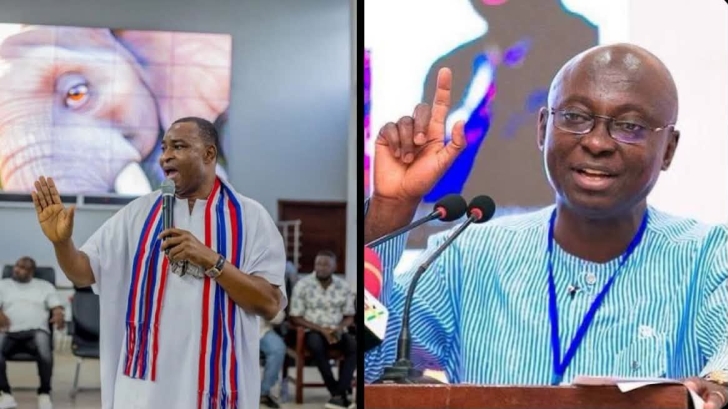
Lawyers for Ashanti Regional New Patriotic Party (NPP) Chairman, Bernard Antwi-Boasiako, popularly known as Chairman Wontumi, have asked the High Court to refer provisions of the Minerals and Mining Act used to prosecute their client to the Supreme Court for interpretation.
In his written address, Samuel Atta Akyea told the trial court that should the case not be referred to the Supreme Court, Chairman Wontumi ought to be acquitted on the charges filed by the Attorney-General.
The Attorney-General has accused Chairman Wontumi and his company of permitting two persons to undertake mining operations on the company's mining concession without approval from the sector minister, in breach of the law. He is facing two counts of assignment of mineral rights without approval and two counts of purposely facilitating an unlicensed mining operation at Samreboi in the Western Region.
Chairman Wontumi has pleaded not guilty to the charges at the Criminal Division of the High Court, presided over by Justice Audrey Kocuvie-Tay.
Counsel wants the Supreme Court to determine whether, on a true and proper interpretation of Article 19(11) of the 1992 Constitution, Section 14(1) of the Minerals and Mining Act, 2006 (Act 703), one of the provisions underpinning the charges against his client, is legally vague, overbroad and inconsistent with the letter and spirit of the said article, and therefore unconstitutional, null and void.
He also wants a determination on whether, on the same constitutional test, Section 99(2)(b) of Act 703, as amended by Section 3 of the Minerals and Mining (Amendment) Act, 2019 (Act 995), and which likewise forms the basis of some of the charges, is legally overbroad and inconsistent with the letter and spirit of Article 19(11), and therefore unconstitutional, null and void.
A further question seeks a ruling on whether the charges in counts four and six against A1 and A3, which were founded solely on Section 99(2)(b) of Act 703 as amended, are themselves inconsistent with the letter and spirit of Article 19(11), and therefore unconstitutional, null and void.
Judgment is scheduled for July 20, 2026.
