
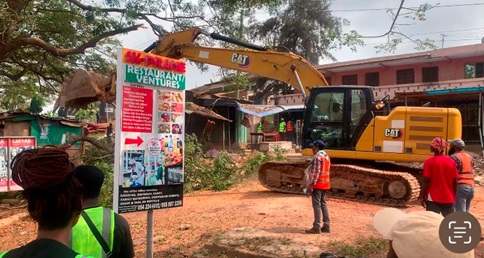
Big Push progresses steadily amidst heavy encroachment
The expansion of cities with vehicular and human traffic increases should come with corresponding improvements in social infrastructure, ease congestion and improve productivity.
But in most cases, that is not the situation in most of the country’s fast-growing cities. There is no order as spaces designated for future social services are encroached upon by petty traders, mechanics, dress makers, hairdressers, among many others, on the orders of assemblymen.
The kilometers
The chiefs and people of the Western Region in October last year welcomed the dualisation of the 73km Takoradi-Cape Coast section of the National Highway One (N1) as the President cut sod for the commencement of construction works.
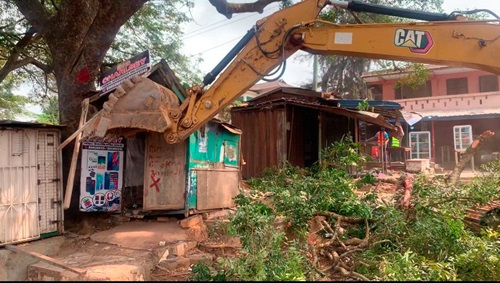
An excavator clearing some stores to make way for the project to continue
The project involves the expansion of the existing single-carriageway into a modern, dual-carriage highway, complete with improved drainage systems, pedestrian walkways, and other safety features.
The government said the Takoradi- Cape Coast Road, at its current state, is a critical project as it has outlived its usefulness and caused a lot of accidents, hence the need to modernise it to improve the productivity of both the Central and Western regions.
The project, after the sod-cutting, is progressing steadily; however, there are challenges.
For years, many traders and unauthorised land grabbers, power-brandishing assembly members allotted these reserved areas and allowed for the erection of permanent and temporary structures on the stretch, especially in the municipal and metropolis areas.
From Cape Coast to Takoradi, there are thousands of unauthorised structures that do not have permit and they ignore the fact that the areas where these structures are located are designated areas for future road expansion and social services.
Encroachments
The Daily Graphic’s checks indicate that the Cape-Coast-Takoradi Highway, once a decent highway, has been heavily encroached upon by thousands of food vendors, dress makers, vulcanisers, block factories, mechanic shops, electronic shops, fuel stations, market stalls, and even homes, with owners of these structures having a high sense of entitlement.
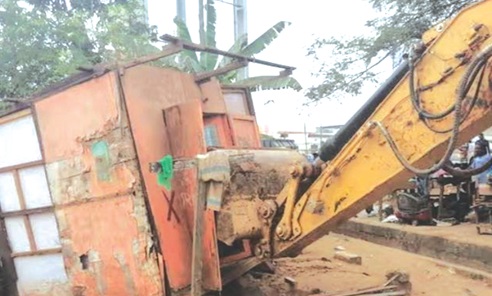
An excavator lifting a shop from its original site
The encroachment at some sections has narrowed the road, making it difficult for large trucks and other large-sized vehicles to manoeuvre.
In cases where a large vehicle becomes defective, it results in hours of traffic, affecting productivity.
Currently, haulage trucks from neighbouring countries and truckers hauling from the Port of Takoradi to other parts of the country as well as other landlocked countries go through a lot of difficulties arriving or departing the city with their loads.
With the new highway finally under construction, promising to boost trade and easy connectivity, it will help increase productivity and drastically reduce the travel time between Cape Coast and Takoradi, which is now two hours.
The project is also expected to boost economic growth, improve access to essential services such as health and education, access to the port, reduce travel time, and open up the broadways for international access linking Cote d’Ivoire in the West.
24-hour economy
With the country’s 24-hour economy starting with port services, and other government agencies, the expansion of the road under the Big-Push linking Accra-Takoradi, Kumasi-Takoradi, Western North to the Port of Takoradi is long overdue.
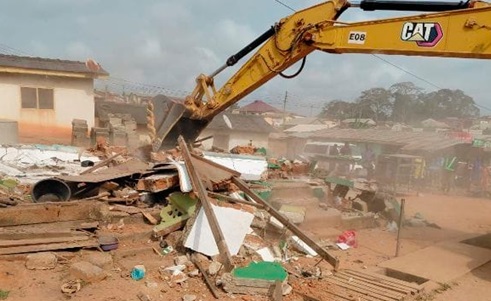
An excavator clearing some debris from the project site
Even though there are many structures on the right of way, demolition exercise by the contractors in the metropolitan and municipal areas started from the PTC Interchange and stretches through Tanokrom, Effiakuma, Kojokrom and Inchaban towards Shama and other stretches leading to Asoko, Anto, Daboase Junction to Beposo, all the way to Cape Coast.
The demolition by the contractors, which is inevitable, has seen the pulling down of temporary structures along the stretch to pave the way for the redevelopment amidst wailing and insults from the encroachers who think the development project should wait.
Self-acclaimed land owners
In some cases, those who rented from others who claim ownership of the stretch are heading to rent control offices for mediation as the supposed owners are not willing to refund.
The interesting thing is that those who have erected temporary and permanent structures are aware of the pending project meant for public good but are not ready to evacuate since many projects in the past started but were abandoned midway.
While others realised the seriousness and evacuated, others are reluctant and want to attract public sympathy, but the Engineer at the Effia Kwesimintsim Municipal Assembly (EKMA), Ishmael Adusei, says contractors will no longer tolerate delay tactics employed by the owners of the affected structures.
Demolition
“The truth is that, owners, residents and businesses operating along the road were given ample notice and sufficient time to relocate before the commencement of the demolition, but they did not take it seriously,” he said.
Those who are busy dismantling their structures were given some time to complete the process, warning that failure to do so would result in the demolition of remaining properties.
The nonadherence to land reserved for public use in the metropolitan, municipal and district assemblies has turned the beautiful layouts of these urban areas into slums inundated with kiosks generating tons of waste without proper disposal sites.
The ongoing construction is a wake-up call to local authorities, district assemblies, municipal and metropolitan assemblies to ensure that areas designated for public use are protected.
Hidden dangers
The trouble stems from the fact that, in both conventional and district level elections, potential assembly members and so-called land owners with political ambitions, arrogate power to themselves and allocate these reserve areas to members in the communities for hairdressing salons, dressmaking shops, taxi ranks, drinking spots and chop bars, among others, in exchange for votes.
The danger is that most of these temporary and permanent structures are sitting on fire hydrants, underground electric cables, overhead pylons carrying high voltage and other utility cables.
In case of disasters, these same people turn to shift the blame and the big push should therefore not only push roads but also push the local assemblies to ensure that the assembly members do not have the right to allocate space for these temporary structures.
Industrial Park
In order to ensure that people’s livelihoods are not affected, these assemblies should consider the creation of semi-industrial parks where all these dressmakers, hairdressers, plumbers, electronic or air condition repairers can work and not along or within reserve areas.
Meanwhile, the big push project linking the Western, Western North, Central and Ashanti regions is progressing steadily, as residents also call for the road to be linked to the abandoned PTC interchange or the Nkrumah Roundabout.
