
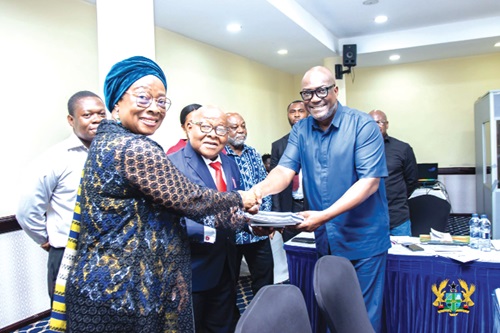
The Institute of Economic Affairs (IEA) has proposed that the advice of the Council of State to the President must be legally binding, as part of sweeping constitutional reforms to strengthen accountability and good governance.
The policy think tank argued that the current arrangement, where the President was not obligated to heed the council’s advice, rendered the body ineffective and undermined its intended role as a check on executive power.
Presenting the IEA Constitutional Review Report to the Constitutional Review Committee in Accra last Wednesday, it blamed the current situation on a Supreme Court decision, which ruled that advice from the Council was not binding because there was no constitutional provision mandating it.
The IEA therefore suggested that the constitution be amended to clearly mandate the President to be bound by the advice of the council.
It, however, proposed that if the President chose not to take the advice, he should be required to give reasons in the name of accountability.
It also proposed significant reforms to the composition and selection process of the council to ensure that the Head of State and the government received the best advice.
Furthermore, the IEA called for a shift towards more representative and credible leadership, emphasising the need for changes that would restore the council’s integrity and strengthen its advisory role to the President.
Regional representatives
A statesman and a private legal practitioner, Sam Okudzeto, for instance, raised concerns about the current election of regional representatives to the Council of State, describing the process as deeply flawed and susceptible to corruption.
He pointed out that electoral colleges responsible for choosing these representatives were often influenced by money and personal interests, resulting in individuals with questionable integrity being selected.
Mr Okudzeto believed that this undermined the council’s purpose as a body of trusted advisors, as those elected often lacked the moral standing and experience required to offer sound counsel to the President.
“When they come to the council, you look at them, you realise that they have nothing of contribution that they can make.
And yet, they are your colleagues, so you can’t attack them,” he lamented.
“So, the process of electing or getting that electoral college is something that is very important for you to look at.
Someone was suggesting that, wouldn't it be better if the assembly as a whole would sit, debate, and then choose someone, maybe even from amongst them, rather than these money people who are coming from outside to get voted,” he added.
No presidential appointees
Former Speaker of Parliament, Professor Mike Oquaye, also called for sweeping changes to the Council of State’s composition.
He criticised the current practice of presidential appointments, describing it as culturally inappropriate.
Prof. Oquaye argued that no president should have the power to appoint members of the Council, likening it to traditional governance systems, saying chiefs do not appoint their advisors.
Rather, he proposed that professional bodies such as the Ghana Bar Association (GBA), the Ghana Institution of Engineers (GhIE) and the Ghana Academy of Arts and Sciences, among others, along with traditional authorities, should nominate representatives.
Additionally, Prof. Oquaye recommended that the most senior retired public officers, including former Chief Justices and Inspectors General of Police, be automatically included in the Council to minimise political bias.
He advocated a return to the constitutional frameworks of 1969 and 1979, which he argued were more apolitical, stressing that the council should not be a platform for trivialisation.
Tenure
The institute also recommended that the tenure of the Council of State should not be tied to that of the President, arguing that the current arrangement allowed incoming presidents to remove and replace members, thereby undermining institutional continuity.
To address this, the IEA proposed overlapping terms and the inclusion of former heads of state on the council to ensure experience, stability and continuity in its advisory role.
Abolishment
The Chairman of the committee, Prof. Henry Kwesi Prempeh, revealed that there was a growing and surprisingly strong public sentiment calling for the abolishment of the Council of State in the committee’s ongoing constitutional review process.
He explained that as the committee engaged various stakeholders, many described the Council as ineffective and redundant, arguing that its advisory role was often ignored by the President.
Prof. Prempeh further stated that part of the calls for abolition stemmed from the recurring practice of creating new bodies, such as the Peace Council or ad hoc groups of eminent persons, to handle national crises and sensitive governance issues that the Council of State was supposedly mandated to address.
Separation of Powers
On the broader governance structure, the IEA called for a strict separation of powers, insisting that Members of Parliament (MPs) should not hold ministerial positions, serve on boards or take up any other executive roles, as this practice breeds conflict of interests and compromises legislative independence.
The institute further argued against the country’s hybrid political system, which allows the executive to exert undue influence over the legislature.
They criticised the persistent control of the “mother parties” over MPs, especially in the selection of parliamentary leadership, such as the Majority or Minority Leaders and Chief Whips.
As a remedy, the IEA proposed secret balloting for such positions within parliament and advocated reforms that would further insulate parliament from direct party control, thereby strengthening its independence and ability to function as a true check on executive power.
