
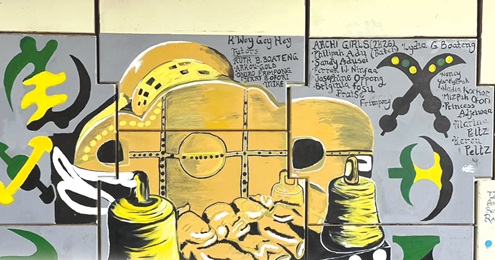
Creativity at play: SHS Visual Arts students transform Asokwa interchange with beautiful murals
It was a moment of pride and joy when hundreds of Visual Arts students drawn from selected senior high schools in the Ashanti Region gathered at the precincts of the Asokwa Interchange to give it a facelift.
Most often than not, these students gather to engage in sporting activities, dancing, cultural and live band competitions, among others.
However, this time around, the essence of the gathering was unique as the visual arts students came together to showcase their drawing and painting skills, as well as creative abilities on walls and piers of the interchange.
Murals
Akin to murals which is a common feature often witnessed on walls, floors and buildings in public places and often designed to enhance environments, convey social-cultural messages and engage with the people, the young students brought their creativity to bear by making several paintings towards the transformation of the interchange.
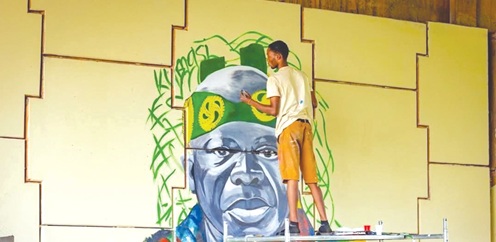
A student working on an artwork of the Asantehene, Otumfuo Osei Tutu II
A mural is a large-scale artwork painted or applied directly onto a permanent wall, ceiling or floor, often integrated into the architectural space.
They are usually large, making them one of the most accessible forms of public art.
It is often used for storytelling, documenting history, educating and expressing social or political messages and ranges from prehistoric cave paintings to modern city murals usually depicting several issues.
The activity, duded “Street arts festival,” which ignited the passion of painting among the students during a four-day street art festival, formed part of the programme of activities lined-up to mark this year’s Ashanti Festival.
Under the supervision of their teachers, the students gave a facelift to the Asokwa interchange which had been defaced with posters and other materials intended to give information to the general public.
Artworks
They showcased artworks of President John Dramani Mahama, the Asantehene, Otumfuo Osei Tutu II, Yaa Asantewaa I, the Queenmother of Ejisu, late Ghanaian music icon, Charles Kwado Fosuh popularly known as Daddy Lumba together with other artworks.
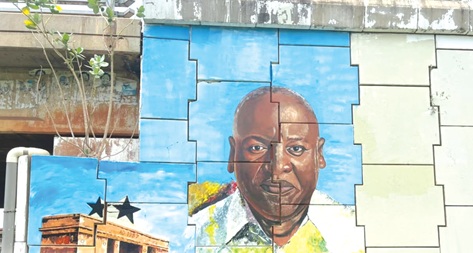
A painting of President John Dramani Mahama
The works and paintings of the enterprising students attracted hundreds of people including passer-by who thronged the venue to catch a glimpse of their artworks at first-hand and commended them for their efforts.
Drivers of private and commercial vehicles honked their horns as they passed by to appreciate them for their collective efforts towards the beautification of the interchange.
Brain behind
Spearheaded by the Regional Coordinating Council under the able leadership of the Regional Minister, Dr Frank Amoakohene and supported by corporate bodies and individuals who provided paints, brushes and other materials, the talented and enthusiastic students have transformed the entire walls of the interchange to the admiration of the public.
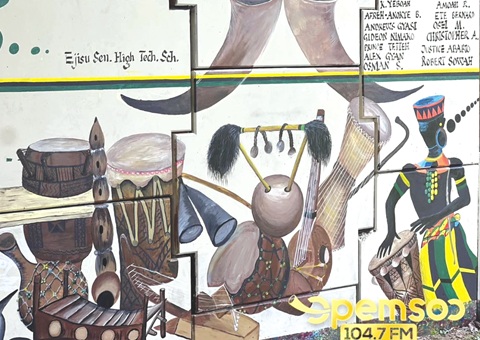
An artwork by Ejisu Senior High Technical School
It is obvious that the opportunity given to the students enabled them to practicalise whatever they had been taught in school, thereby preparing them for better job opportunities after completing school.
Some of the 30 participating schools were the Kumasi Anglican SHS (KASS), the Kumasi Wesley Girls, the Ejisuman SHS, the St Loius SHS, the Kumasi Girls SHS, the Prempeh College, the Serwaa Nyarko Girls SHS, the Pentecost SHS.
Others were the Afua Kobi Ampem Girls SHS, the Gyaaman Pensan SHS, the Adventist SHS, the Kumasi High School, the St Monica’s SHS, the Adventist Girls SHS, the Kumasi Senior High Technical, the Ejisu SHS, Asanteman SHS, among others.
Unearth skills
Speaking during the official launch of the Ashanti Festival, Dr Amoakohene, said the arts festival was intended to unearth the creative skills of the students and to enable them to develop their career in the field.
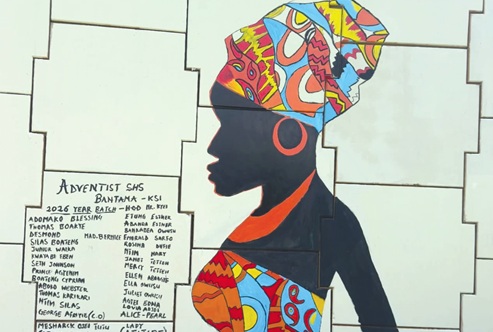
A painting by the Adventist SHS, Bantama
He said “it is an important opportunity for the young student to bring to light what they had been taught in school for the benefit of the society.
This is a privilege given to them to give back to the state at a younger age”.
The Chief Executive, Kumasi Metropolitan Assembly, Richard Ofori-Agyeman Boadi, in a remark during a visit, lauded Dr Amoakohene for providing the platform for the students to improve upon talents and skills.
He said, “this will go a long way to boost the morale and abilities of the students to develop their capabilities to set up their own firms after completion, thereby improving the informal sector”.
For her part, Janet Abobigu of Uni-Jay Limited, encouraged the students not to allow themselves to be looked down upon for offering visual arts, saying “I urge you to be committed and passionate about it. This course will make you self-employed”.
MCE speaks
The Municipal Chief Executive for Asokwa, Amoh Kamel, said after assuming office and considering the state of the interchange, a proposal for an estimate towards its beautification was made to the Kwame Nkrumah University of Science and Technology (KNUST).
However, he said the cost was unbearable for the assembly and he discussed it with the regional minister who decided to put a number of SHS students together during the Ashanti festival to paint the facility.
Although initially skeptical about what the students could do, he said he was overwhelmed by the exploits and raw talents of the students, adding that the assembly would fence the place to protect it and for people to have access only for photo sessions.
Welcome opportunity
In an interview, some of the students welcomed the opportunity given to them to showcase their skills, saying “we believe that such platforms should be offered regularly for us to translate theory into practice”.
Further, they called for the resourcing of the visual arts departments of their various schools to enable the students to have the requisite teaching and learning materials in their academic pursuit.
New curriculum
Some visual arts teachers commended the students for their exceptional creativity and showcasing what they had been taught in school through their art works.
However, they expressed concern about the newly introduced SHS curriculum as it would not allow visual arts students to acquire the needed in-depth skills to enhance teaching and learning.
They said they were nine domains in visual arts but has been reduced to two, namely foundation and studio, saying “it is worrying that nine disciplines under visual arts have been merged into just two”.
“The current system will make it very difficult for Ghanaian students to compete with their colleagues in the United Kingdom and other advanced countries when opportunities arose,” they said.
They said “if we want to develop the talents and skills of the students, then there is the need to revisit the old curriculum which was more practical in nature.
The students now lack the practical feel of visual arts as a programme”.
Writer’s email;
