
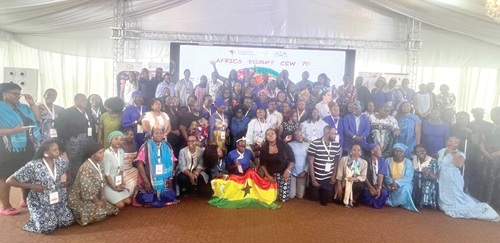
CSOs, women’s right organisations meet in Accra ahead of CSW in New York
Ahead of the 70th session of the Commission on the Status of Women (CSW70) slated for March 9 to 20 at the United Nations Headquarters in New York, USA, a three-day meeting has been held in Accra by civil society organisations (CSOs) from across Africa to come up with an African position for the meeting.
The Commission on the Status of Women (CSW) is the world's main policy-making body dedicated exclusively to gender equality and the advancement of women, held annually for two weeks at the UN Headquarters in New York.
Established in 1946, the CSW brings together member states to shape global standards, review progress and formulate policies on women's rights.
The Accra meeting, dubbed ‘Africa Disrupt CSW70’, which started five years ago in Africa ahead of the CSW meetings, provides African CSOs the opportunity to put their concerns together and present at the meeting as a united front.
The Accra meeting, hosted by WiLDAF Ghana and initiated and funded by the African Women's Development and Communication Network (FEMNET), brought together participants from East, West, Southern and Central Africa, as well as representatives working at regional and continental levels to deliberate on what they expect from CSW70 in New York, USA.
Held on the theme: “Advancing Access to Justice for Women and Girls in Africa”, the meting was aimed at deepening the understanding of CSW negotiation processes and the political implications of language in agreed conclusions, to strengthen African civil society coordination and influence in global norm-setting space to build practical advocacy skills for engaging national delegations and Permanent Missions, as well as to analyse emerging threats to women’s rights within African and global policy contexts and also to adopt a unified call to action on access to justice for women and girls in Africa.
Alternative space
The Executive Director, FEMNET, Memory Kachambwa, in an interview after the three-day meeting, said Africa Disrupt serves as a critical alternative space for those unable to travel to New York to influence policy and demand transformative legal reforms.
She said CSW was the process of bringing accountability to the implementation and realisation of gender in women's rights and, in particular, the Beijing Platform for Action.
So we are going right to the grassroots, right to the community, where we are talking about CSW, a global event, because we want inclusion, we don't want it to be just for the few”.
“We went to Malawi, we went to Botswana, we went to Cameroon.
Now we are in Ghana, and we have seen the ministers of gender on board; we have also seen other partners, who are also coming to listen.
What we are taking to CSW in the next three weeks will be action points from an African context, including what are some of the barriers in terms of access to justice, which is the priority theme.
We want to hold our member states responsible for making sure that there's access to justice in so many ways.
Proactive strategy
The Executive Director, WiLDAF Ghana, Melody Darkey, in a welcome address, expressed appreciation to participants for their commitment and acknowledged partner institutions and supporters whose contributions made the convening possible.
She underscored that Africa Disrupt was not merely a pre-CSW meeting, but a political organising space intentionally designed to strengthen African feminist influence within global decision-making arenas.
She highlighted the shifting geopolitical landscape and noted increasing coordination among anti-rights actors who seek to dilute established commitments on gender equality, saying progress achieved through decades of feminist advocacy remained vulnerable.
“We cannot afford symbolic participation. Our presence must be strategic, coordinated and grounded in the lived realities of African women and girls,” she added.
She called on African civil society to move from reactive engagement to proactive strategy, saying their presence in New York was insufficient without preparation, alignment and national-level engagement.
She said CSW70 was an opportunity to reinforce global commitments that directly impact national accountability, stressing that weakening language at the global level can embolden regression domestically.
Writer email:
