
Goosie Tanoh urges crackdown on customs malpractices to boost 24-Hour Economy
The Presidential Advisor on the 24-Hour Economy, Augustus Tanoh, has urged Customs House Agents (CHAs) and freight forwarding associations to take a firm stance against malpractices in Ghana’s trade and logistics sector, describing such acts as a threat to national development.
He highlighted concerns over abuses in customs transit regimes, bonded warehouses, and auction processes, as well as the misclassification and undervaluation of goods, emphasising that vigilance and strict adherence to ethical practices could eliminate such economic sabotage.
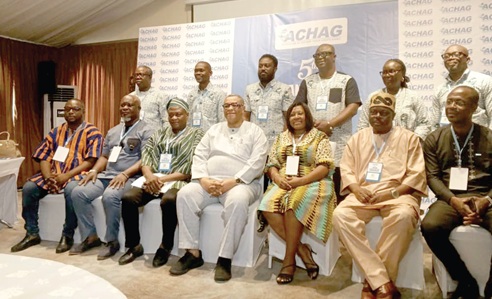
Mr Tanoh made the call at the fifth Annual General Meeting (AGM) of the Association of Customs House Agents, Ghana (ACHAG) last Saturday at the Royal Senchi Hotel, in Akosombo, held on the theme: “CONNECT 24: The Role of the Customs House Agent in the 24-Hour Economy.”
“As customs, ports, and regulatory agencies move towards real-time, data-driven, single-window clearance systems, these abuses will progressively diminish,” he said.
He called on the freight forwarding industry associations to demonstrate courage and accountability by sanctioning or expelling members who sought illicit gains at the expense of national development, employment, and government revenue.
Mr Tanoh also outlined the broader vision of Ghana’s 24-Hour Economy programme, whose aim was to build a connected, competitive, and self-reliant domestic industrial base while positioning the country as an export-ready hub for West Africa.
“The 24-Hour Economy is not just about extended working hours; it is about creating a system where trade is efficient, transparent and reliable,” he added.
Professionalism
The Head of the Suspense Division of the Ghana Revenue Authority, Nana Brago Owusu Ansah, praised CHAs for their contribution to revenue generation and trade facilitation, urging them to uphold professionalism, integrity and digitalisation.
The Head of Freight and Logistics at the Ghana Shippers' Authority (GSA), Fred Asiedu-Dartey, speaking on behalf of the CEO, Prof. Ransford Gyampo, said a functional 24-hour economy could not exist without a logistics ecosystem that was digitally enabled, procedurally predictable and operationally responsive.
He stressed that customs house agents served as the vital link between traders, regulatory authorities, ports, borders, and logistics service providers, noting that their responsibilities would expand under a round-the-clock operational framework.
According to him, digital trade facilitation—through automation, electronic documentation, system integration, and data transparency—was the backbone of a 24-hour economy.
He, therefore, urged CHAs to continually invest in digital competence and skills development to remain effective in an “always-on” trading environment.
Integrity
The outgoing President of ACHAG, Akwasi Sereboi Boateng, called on CHAs to raise professional standards and adapt operations to support the 24-hour economy.
He noted that global trade did not operate within traditional office hours, as vessels arrived at ports and aircraft landed at airports around the clock.
According to him, the success of Ghana’s 24-hour economy—particularly at ports and borders— would depend largely on the efficiency and integrity of CHAs.
Mr Boateng described customs house agents as critical facilitators of trade and protectors of national revenue, whose responsibilities will expand under a 24-hour operational regime.
He urged agents to invest in staffing, shift systems, and resilient business structures to deliver professional services at all times.
“The CONNECT 24 agenda presents a real and significant opportunity.
More cargo, more declarations, more transactions, and more clients are coming as Ghana positions itself as the trade gateway of West Africa.
The Boankra Inland Port, the Eastern Corridor, and the expanding Tema Port all point to a growing market,” he said.
Mr Boateng also highlighted the importance of the Integrated Customs Management System (ICUMS) and expressed concern about the activities of unlicensed agents, assuring that ACHAG would work with authorities to curb the menace.
He further noted ACHAG’s focus on capacity-building, including AfCFTA training, to equip members for evolving trade regimes.
Collaboration
The Director-General of the Ghana Ports and Harbours Authority, Major General Paul Seidu Tanye-Kulono, in a speech read on his behalf by Solomon Anderson, called for stronger collaboration to maintain efficient ports.
He outlined four priorities for CHAs: delivering consistent 24-hour services, adopting digital solutions, investing in continuous professional development, and maintaining high ethical standards.
He stressed that the success of a 24-hour economy would be measured by faster port turnaround times, lower logistics costs and higher compliance levels.
Writer's email:
