
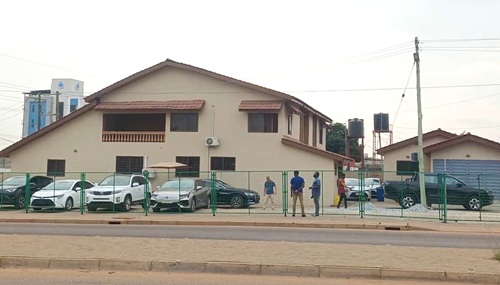
A car dealership has within a week’s deadline to stop showcasing vehicles on the pavement near the East Legon ARS Roundabout or face sanctions from the La Nkwantanang Madina Municipal Assembly (LaNMMA).
The company, Sanli Tianyou Motors, a Chinese-Ghanaian joint venture, has extended its wire mesh fence wall onto the pavement to create space for displaying vehicles, thereby obstructing pedestrian and commuter movement.
The practice, including trading, hawking and displaying goods on walkways, pavements and footbridges are prohibited under the bye-laws of the assembly.
However, the company disputes the claims that it is encroaching, in its defence it explained that it had already paid and secured a business operating permit and an additional permit from LaNMMA to demolish the original fence wall and also use the pavement to park and display vehicles for sale.
The Daily Graphic’s interest in the issue follows concerns raised by some residents about the impact on the mobility of vulnerable members of the community, including the elderly, persons with physical disabilities (PWDs), particularly the visually impaired.
Community visit
When the Daily Graphic visited the community, it observed that the company, housed in a two-storey building near the ARS Roundabout at East Legon, had extended its fence by more than five metres from its premises towards the pedestrian walkway opposite the Frimps Oil outlet on the American House–Ogbojo Boundary Road.
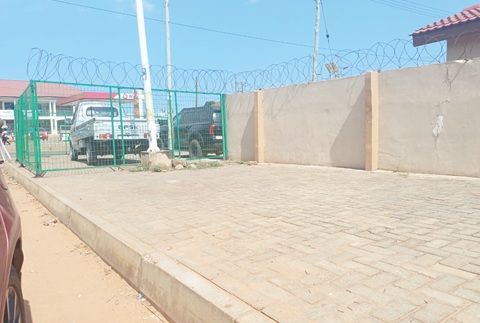
The company has broken down part of its concrete block wall and extended a metal mesh fence close to the give-way signpost mounted on the pavement, using the additional space to display vehicles for potential buyers.
The Daily Graphic team also observed that part of the gutter had been covered, creating the false impression that there is sufficient space for pedestrians.
However, a close inspection reveals that the available space was considerably narrower than it appears from afar, especially for PWDs.
When the team contacted the company about the encroachment, it initially insisted that it had obtained several permits to use the space; however, it failed to produce any of the permits, in spite of repeated requests by the team to see them.
LaNMMA’s position
In an interview with the Daily Graphic, an official of the assembly, who said he needed approval from the Municipal Chief Executive (MCE) before speaking on record, confirmed that the company had encroached on the pavement and had consequently been given a two-week notice to remove the structure or face sanctions by the first week of September.
“They have come onto the pavement and it is against the law.
We have gone there and informed them about it.
We gave them two weeks’ notice, and one week has already passed, so they have until next week to remove their wall,” the official stated.
The official said the assembly had not issued a permit to the company to park or display vehicles for sale on the pavement, but rather explained that the permit granted was temporary and only covered the installation of a tent, canopy or temporary shed.
The assembly’s official gave the assurance that the fence would be cleared soon, saying the assembly was taking steps to address the situation.
Sanli’s position
In an interview with the Daily Graphic at the company’s premises, a manager of Sanli, Chris Owen, defended the company’s decision to use part of the pavement to park and display its vehicles, saying the necessary permits had been obtained from LaNMMA.
He explained that the company began operations at the current location in March, this year, and initially parked vehicles outside the premises and pavements without facing any complaints from the assembly or residents.
He stressed that the company had been parking vehicles on the pavement for about four months before deciding to demolish part of the original concrete fence wall to construct a metal mesh fence to create more space for displaying its vehicles.
Permits obtained
“We actually made a payment to LaNMMA. We got a permit from them to operate. Initially, when we told them we wanted to operate the business, we got the business operating permit.
Then we told them that we wanted to set up a fence, so we spoke to them and they agreed,” Mr Owen said.
He added that the company paid GH¢2,500 to the assembly in connection with the permits, and it was also issued a receipt for the payment.
Mr Owen explained that the company’s decision to extend the fence was prompted by the difficulty of repeatedly moving vehicles in and out of the premises, particularly at the end of each business day.
When asked to show the permit, he explained that the company had not been given a written permit specifically covering the fence extension, although he maintained that the necessary approvals had been obtained.
