
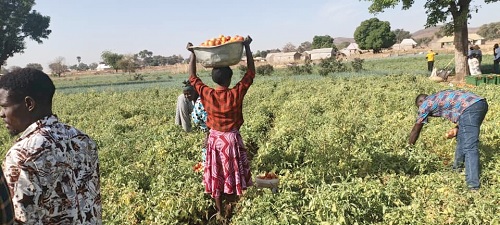
A strategic partnership between the West Africa Food System Resilience Programme (WAFSRP) and agribusiness firm, FarmMate Ltd, has significantly boosted tomato production in Ghana, recording an estimated 240 tonnes of tomatoes in its first round of production in the Upper East Region.
The achievement, recorded during the 2025 dry season, formed part of deliberate efforts to tackle Ghana’s perennial tomato shortages and price volatility, especially between December and May, when imports surge.
The beneficiary communities included Zebila (Bawku West District), Pwalugu (Talensi District) and Navrongo (Kasena Nankana District).
Other project sites across the country are Ningo-Prampram, Okere, Kwahu East, Akumadan Irrigation Scheme and Asunafo South District.
Farmers under the programme received smart seeds, blended fertilisers enriched with micronutrients, organic manure, and both organic and inorganic pesticides from FSRP, while FarmMate Ltd provided close extension support, monitoring, and guaranteed off-take of harvested tomatoes for both fresh consumption and value addition into tomato paste.
Partnership
Addressing the media during a field visit to Zebila in the Bawku West District, the Project Officer coordinating the tomato initiative at FSRP, Dr Gabriel Owusu, said the collaboration demonstrated how public–private partnerships could transform local food systems.
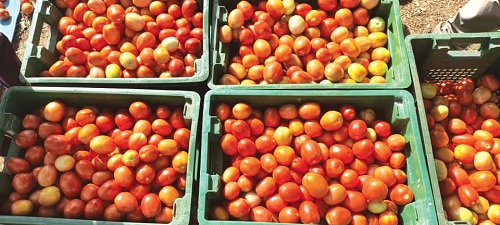
He explained that the initiative fell under the WAFSRP implemented by the Ministry of Food and Agriculture (MoFA) with financial support from the Government of Norway and coordinated by the World Bank.
“The objective is to revamp Ghana’s tomato industry through dry season production and ensure year-round availability,” he explained.
Under the FSRP–FarmMate collaboration, Dr Owusu said 200 acres of tomatoes were being cultivated nationwide, 110 acres of which are located in the Upper East Region, engaging about 100 farmers.
Why Tomatoes
Dr Owusu highlighted that tomatoes accounted for about 40 per cent of vegetable expenditure in Ghana, yet only 34 per cent of the 1.4 million tonnes consumed annually were produced locally.
The gap, he said, fuelled massive imports and price instability.
He noted that key challenges confronting the industry included poor-quality seeds, climate variability, pest and disease pressure, weak agronomic practices, and post-harvest losses of between 20 and 60 per cent, all contributing to low average yields of 8.3 tonnes per hectare, far below the potential 20 tonnes per hectare.
Citing its early success in the Upper East Region, he said the FSRP–FarmMate tomato initiative was emerging as a replicable model for strengthening Ghana’s food security, stabilising prices, creating jobs for the youth and women, and reducing the country’s dependence on tomato imports.
Beyond FarmMate, Dr Owusu said the FSRP Tomato Support Programme is currently operating in 17 districts across four regions, involving 1,500 farmers, 40 per cent of whom are women.
Working closely
The Head of Engagement for FarmMate, who also manages its Environmental, Social and Governance (ESG) systems, Kwame Asante, noted that FarmMate had been working closely with the FSRP over the past year, primarily to address challenges such as access to reliable markets confronting tomato farmers in Ghana.
“As part of our mandate, FarmMate off-takes tomatoes from participating communities, but to ensure quality produce, we also provide technical support to farmers, covering nursery development, transplanting, farm and crop management, harvesting coordination, aggregation, and the transportation of tomatoes from production zones to Accra,” he said.
Mr Asante disclosed that the company plans to expand production to at least 1,000 acres by 2026, with an estimated minimum yield of four tonnes per acre, translating into about 4,000 tonnes of tomatoes annually for both the fresh market and processing.
Exploitation and Post-Harvest Losses
The Bawku West District Director of Agriculture, Diana Akumanue, praised the initiative, particularly FarmMate’s off-take and payment system.
“One good thing about FarmMate is that they use a weighing system and pay farmers based on weight, unlike the market queens who just use crates,” she noted.
She added, “The pricing is agreed collectively with the farmers, harvesting is done together, sorting is done on-site, and payment is prompt.
This has significantly reduced post-harvest losses, and farmers are pleased.”
The Upper East Regional Crops Officer, Yakubu Mohammed Awal Mei-goro, described the 2025 season as exceptional for tomato farmers in the region.
Appreciation
A farmer, Agosh Apambila, speaking on behalf of his colleagues, expressed deep appreciation for the initiative, describing it as crucial to their success in farming.
He noted that the introduction of improved seeds had significantly boosted their yields, explaining that, unlike in the past when farming was done without proper inputs, they were now enjoying good harvests as a direct result of the support received.
