
Galamsey complex for one institution to tackle — KAIPTC Commandant
The complexities in the fight against illegal mining cannot be addressed through isolated interventions, the Commandant of the Kofi Annan International Peacekeeping Training Centre (KAIPTC), Air Vice Marshal David Anetey Akrong, has said.
“It requires sustained collaboration among institutions, communities, traditional authorities and development partners, guided by a shared commitment to safety, accountability and inclusive development,” he said.
The commandant said winning the fight against illegal mining was not the preserve of any institution, adding that it “must be a coordinated all-hands-on-deck by stakeholders”.
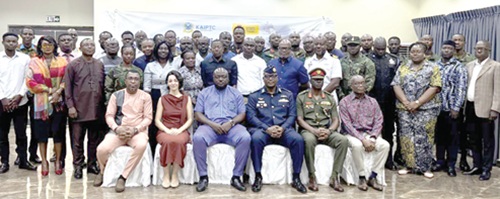
He was addressing a two-day validation and policy dialogue workshop in Kumasi in the Ashanti Region on the safety and security dimensions of illegal small-scale mining last Tuesday.
The workshop formed part of an applied research and stakeholder engagement initiative aimed at examining the governance, environmental and human security impact of galamsey in selected communities across the Ashanti and Western regions.
The initiative, led by the KAIPTC, in collaboration with the Embassy of Spain, brought together policymakers, security and regulatory institutions, development partners, and civil society leaders to consolidate regional recommendations into a coherent national policy roadmap.
The validation process was, therefore, designed to provide a structured platform for regional and national actors to review the findings, contribute institutional perspectives, and jointly develop practical, evidence-informed policy recommendations that strengthen coordinated and sustainable responses.
Revelation
Air Vice Marshal Akrong said that recent field engagements across several communities in the region revealed that illegal mining had evolved into a complex political and economic ecosystem, adding that it was no longer merely a matter of environmental degradation or licensing compliance.
“It increasingly shapes who controls land and labour, how resources are distributed and how authority and safety are experienced within local communities.
In some districts, the persistence of illegal mining activity has contributed to the emergence of informal power structures that operate alongside, and at times in competition with, formal state institutions,” he said.
The commandant cautioned that over time, this could weaken trust in regulation, enforcement and public administration, while complicating the work of those institutions tasked with maintaining order, protecting communities and regulating the sector.
Air Vice Marshal Akrong mentioned a growing concern emerging from engagements in parts of the region where there was an increasing link between illegal mining and the circulation of illegal or improvised weapons in remote and contested areas.
In certain mining spaces, he said, there were signs of a gradual shift toward heightened security postures, in which the threat or use of force had become a means of protecting financial interests, securing access to land, or deterring rival groups and state interventions.
The Deputy Ambassador of Spain to Ghana and Togo, Isabel Ibarra Serrano de Haro, said illegal mining, which began as an artisanal activity, had evolved into a high-risk, high-impact ecosystem that affected not only the environment but also the safety, stability and social cohesion of communities.
“Today, illegal mining is intertwined with a range of serious security concerns, including human trafficking, sexual exploitation, forced labour, arms proliferation, illicit financial flows, among others,” she alleged.
Ms de Haro said these were not isolated incidents, but formed part of a wider criminal economy that had taken root in Amansie West, Amansie Central, Obuasi and other areas in the Ashanti Region.
“Foreign involvement has added yet another layer of complexity through the introduction of transnational criminal networks, illicit capital and hazardous chemicals that undermine both local governance and national security,” she said.
The Chief Executive of the Asokwa Municipal Assembly, Amoh Kamel, said the fight against illegal mining required evidence-based policies, strong institutions, community engagement and coordinated national action.
Writer’s email;
