
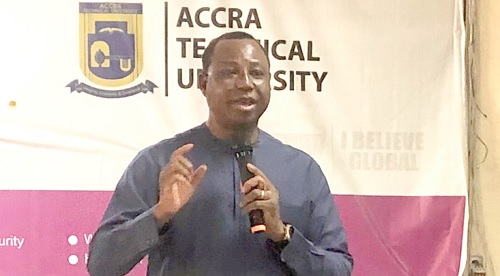
Ghana loses $3bn annually to corruption — CHRAJ Commissioner
The Commissioner of the Commission on Human Rights and Administrative Justice (CHRAJ), Joseph Whittal, has revealed that Ghana loses about $3 billion annually to corruption, cautioning that the persistent financial haemorrhage threatens national development and the prospects of the country’s youth.
He said the losses, which stemmed from tax evasion, smuggling, misapplication of public funds and entrenched leakages, continued to deny the nation the resources needed to improve education, health care, infrastructure and youth empowerment.
Mr Whittal made this known at a symposium held at Accra Technical University (ATU) yesterday to mark this year’s International Anti-Corruption Day.
This year’s celebration was on the theme: “Uniting with Youth Against Corruption: Shaping Tomorrow’s Integrity.”
Collective efforts
The Commissioner said the national fight against corruption required collective efforts, not just the work of state agencies.
“It is not about pointing fingers.
Every citizen must ask what they are doing to fight corruption. If you do not uphold integrity within your own space, how will an anti-corruption body know what is happening there?” he asked.
Mr Whittal urged the youth to become champions of integrity in their communities by refusing bribery, reporting wrongdoing and holding leaders accountable.
The Commissioner of CHRAJ said findings from earlier national corruption perception surveys showed that some public institutions, such as the Ghana Police Service, the Lands Commission, as well as prosecutors, judges and magistrates, consistently ranked high in reported bribery and unethical conduct.
“The survey gives a league table of institutions perceived to be the most corrupt.
The police topped the list, followed by the Lands Commission, and then prosecutors and judges,” Mr Whittal said.
He also said evidence from the 2021 Actual Corruption Survey showed that young people were the age group most likely to pay bribes, which was worrying.
The CHRAJ Commissioner said persons aged between 25 and 34 years recorded a bribery prevalence rate of 29.9 per cent, with those between 18 and 24 years recording 23.9 per cent.
“If nearly half of our youth are already paying bribes, then we must reflect seriously on who becomes the next generation of leaders,” he said.
Mr Whittal further said corruption should not be seen only as high-profile misconduct in public institutions, but also the “seemingly small” unethical practices within educational environments, including acts such as examination malpractice, cheating, favouritism, grade buying and misuse of student funds, were early signs of attitudes that later evolved into greater forms of corruption in public life.
The Director of Anti-Corruption at CHRAJ, Stephen Azantilow, said corruption affected every Ghanaian, including students.
He explained that the canker was not limited to grand political scandals, but included everyday acts such as cheating in examinations, misusing student funds, inflating prices during school events, and abusing small amounts of power entrusted to individuals.
Such behaviours, the Director of Anti-Corruption said, were the seeds that grew into the larger national corruption challenges in the country.
Mr Azantilow added that corruption weakened democracy, increased the cost of development and led to poor-quality public services, because resources meant for the common good were diverted into private pockets.
He urged young people to reflect on whether they saw themselves as the “emaciated worker” who laboured honestly or the “beneficiary” who fed off the system without contributing, and to reject bribery, refuse to abuse privileges and uphold integrity in their daily actions.
ATU
The Vice-Chancellor of ATU, Professor Amevi Acakpovi, said the university remained committed to embedding integrity in its academic and administrative culture, as its motto emphasised Integrity.
