
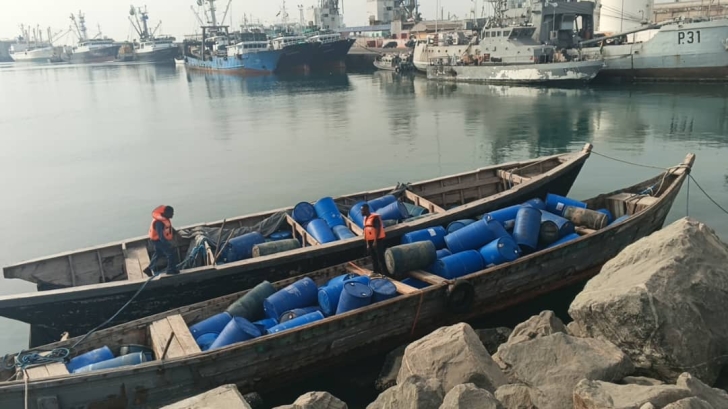
Ghana Navy seizes 7 canoes in Aflao coast operation
The Ghana Navy has intercepted seven irregular canoes suspected of being used for illegal fuel bunkering activities in the Gulf of Guinea, off the coast of Aflao.
The operation, carried out by Ghana Navy Ship (GNS) Aflao last Monday under the command of Lieutenant Commander Albert Brobbey Damoah, formed part of the Navy’s mandate to secure the country’s maritime domain and ensure the safety of legitimate businesses operating at sea.
The interception, which took place one nautical mile off the Aflao coast, led to the seizure of seven canoes, as well as over 400 empty barrels, each with a capacity of about 250 litres, intended for the illegal transportation of fuel into the country.
No arrest was made, as the sailors fled before the arrival of the naval vessel. However, the seven wooden dinghies with the empty barrels were towed to the Tema Harbour to allow for further investigations and to establish ownership.
Speaking to the media yesterday, the Flag Officer Commanding (FOC) the Eastern Naval Command, Commodore Solomon Aseidu-Larbi, explained that the successful operation was the result of actionable intelligence gathered by the Ghana Navy.
Based on the intelligence, he said an operational plan was developed and executed, leading to the deployment of GNS Aflao, which made the crucial interception during its patrol.
Threats
Commodore Aseidu-Larbi warned that illegal fuel bunkering posed serious economic, environmental, and safety risks to the country.
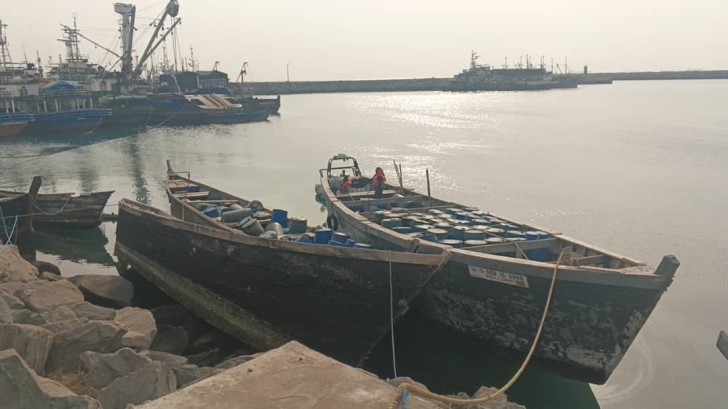
Some of the canoes and empty barrels towed to the Tema Harbour
He explained that because the fuel enters the market without inspection, perpetrators evade taxes, denying the government critical revenue needed for national development.
He added that the unregulated fuel often failed to meet quality standards, leading to damage to vehicles and machinery.
The Commodore also raised concerns about environmental pollution, noting that fuel spillages frequently occur during illegal transfer operations due to the lack of technical expertise among the operators.
“These spillages pollute the marine environment and negatively affect fish stocks, ultimately harming the livelihoods of fisherfolk and threatening food security,” he said.
Commodore Aseidu-Larbi further expressed concern that some local fisherfolk participated in the illegal trade without fully appreciating its negative impact on the national economy and the marine ecosystem.
To curb the menace, he said the Chief of the Naval Staff, Rear Admiral Godwin Livinus Bessing, has directed the deployment of additional maritime assets to patrol the seas and strengthen operations within Ghana’s territorial waters.
He noted that the Ghana Navy would maintain a sustained presence at sea, enhance surveillance capabilities, and deploy more drones to support intelligence gathering.
Commodore Aseidu-Larbi added that the Navy would continue to intensify community sensitisation efforts, particularly among coastal fishing communities, and encouraged residents to cooperate with security agencies by providing information on suspicious activities rather than aiding criminal networks.
He assured the public of the Navy’s commitment to safeguarding Ghana’s maritime domain and ensuring that only legally approved petroleum products were distributed along the country’s coastline.
“The Ghana Navy will continue to do everything within its mandate to protect the nation’s economy, marine environment and coastal communities,” he said.
Modus Operandi
The Command Operations Officer of the Eastern Naval Command, Commander James Dzigbordi Agrah, explained that the modus operandi of those involved in the illicit fuel trade formed a well-organised network that often involved a mothership stationed on the high seas.
“Usually, a mothership anchors beyond Ghana’s 12-nautical-mile territorial waters with fuel stolen from various sources.
Smaller boats or dinghies meet the mothership, where fuel is pumped into drums or directly into the boats.
The fuel is then smuggled to landing sites along the coast and distributed on the local market with the assistance of some local fishermen and community members,” he said.
Writer's email:
