
Economic think tank, Institute for Fiscal Studies (IFS), has urged the government to devise a strategy to generate revenue from the rapidly expanding small-scale gold mining sector.
It said although data showed, for instance, that in 2025, gold exports increased by a remarkable 103.3 per cent, from $10.31 billion to $20.98 billion, with small-scale mining contributing as much as $10.80 billion or 51.5 per cent, the government did not articulate any strategy in the mid-year budget for mobilising revenue from the small-scale gold mining sector, despite the critical need for it.
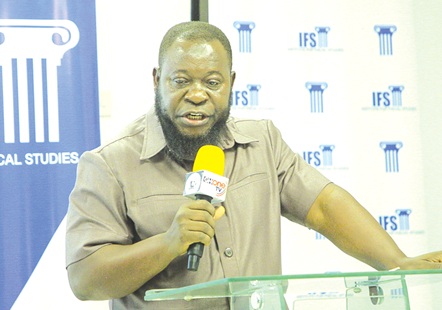
The Executive Director of IFS, Dr Said Boakye, made the call at a press conference in Accra yesterday to present the think tank’s analysis of the government’s 2026 Mid-Year Budget Review.
Speaking on the need for the government to keep to its spending and revenue generation targets to boost economic growth, Dr Boakye said mineral royalties collected by the government, for instance, depended almost entirely on gold production (about 97 per cent), which improved by 21.1 per cent, from $364.87 million in 2024 to $441.82 million in 2025.
However, in spite of the remarkable growth in gold production and exports by the small-scale mining sector, it had not led to any significant growth in mineral revenue, because the government had ignored revenue mobilisation from the sector.
Dr Boakye said recent developments, including the implementation of the Domestic Gold Purchase Programme and the establishment of Gold Board (GoldBod), had revealed that the small-scale mining sector’s contribution to gold production and exports was much bigger than previously recognised.
“However, government revenue generation from the small-scale mining sector is woeful. This situation should not be allowed to persist,” Dr Boakye insisted.
He explained that the country’s mineral resources were publicly endowed and held in trust by the state on behalf of the people.
“Therefore, it is necessary that the state enjoys a fair share of the benefits from the extraction of these mineral resources by whomever extracts them,” he added.
The Executive Director cited information published by the Minerals Income Investment Fund (MIIF) which suggested that all the gold royalties collected in 2025 came from the large-scale sector, with no collections from the small-scale sector despite small-scale gold export constituting 51.5 per cent of the total gold export in 2025 as stated above.
“This is what largely explains the significantly smaller growth rate of mineral royalties relative to the growth rate of gold export in 2025,” the IFS said.
Dr Boakye said information the IFS obtained from enquiries into the matter showed that besides royalties, other key revenue instruments in the current mining fiscal regime (such as corporate income tax) were yielding little to no revenue from the small-scale mining sector.
“Allowing such a situation to persist means the government is not interested in ensuring that growth in gold export generates anything close to commensurate growth in fiscal revenue from the sector,” he stated.
Revenue shortfall
The Executive Director of IFS said government expenditure fell significantly short of target, with critical areas such as capital spending and arrears payments among the worst hit.
Dr Boakye stated that while the government planned to spend GH¢172.54 billion, including arrears payments, in the first half of 2026, actual expenditure fell short by GH¢35.60 billion, representing 20.6 per cent of the budgeted amount.
He said capital expenditure missed its target by GH¢14.38 billion, or 39.3 per cent, while arrears payments fell short by GH¢8.64 billion, representing 61.8 per cent of what was budgeted.
“These two expenditure items are critical for economic growth and development. Arrears payment, for instance, oils economic activities by providing liquidity to government contractors and suppliers, and the businesses that depend on them,” he stated.
Dr Boakye explained that because government expenditure was a key component of Gross Domestic Product (GDP), the restriction had a direct declining effect on growth.
“It is no wonder, therefore, that non-oil real GDP growth momentum declined in the first quarter of 2026,” he said.
“If the government continues to significantly restrict expenditure as occurred in the first half of the year, then non-oil real GDP growth rate is most likely to decline further,” he warned.
Domestic financing
Dr Boakye added that the expenditure gap could not be fully explained by revenue challenges.
He said the combined shortfall in total revenue, grants and foreign borrowing amounted to GH¢8.39 billion, which was less than one-fourth of the total expenditure gap of GH¢35.60 billion.
Instead, he attributed the huge spending shortfall to domestic budget financing, which fell short by GH¢34.45 billion, representing 67.2 per cent of the budgeted GH¢51.28 billion.
“By all indications, this shortfall is the result of a deliberate decision by the government,” he said.
Dr Boakye also raised concerns that while the government was starving the budget of domestic financing, it was simultaneously accumulating funds in the Sinking Fund.
Citing the Minister of Finance, he said GH¢15.6 billion had been accumulated in the Sinking Fund by July 22, this year, an amount that was not announced in the initial budget.
That, he said, raised two critical questions: “Was the government not aware while preparing the 2026 budget that it would raise such a large amount for the Sinking Fund, or was it aware but chose not to capture this in the budget presented to Parliament?”
Dr Boakye said that showed poor planning on the part of the government and that had greatly affected the credibility of the 2026 budget.
The IFS Executive Director added that “a budget is not something to treat casually, such that the Minister of Finance can set targets that he willfully deviates from”.
Data inconsistencies
Dr Boakye also flagged several data inconsistencies in the mid-year budget review that he said further undermined credibility.
He pointed to Appendices 2A and 2B, where the stated total revenue and grants target for the first half of 2026 is GH¢126.14 billion.
However, the sum of the individual revenue components adds up to GH¢125.43 billion, leaving an unexplained difference of GH¢712.43 million.
He added that the inconsistencies, coupled with the spending shortfalls, raised serious questions about budget planning and transparency.
