
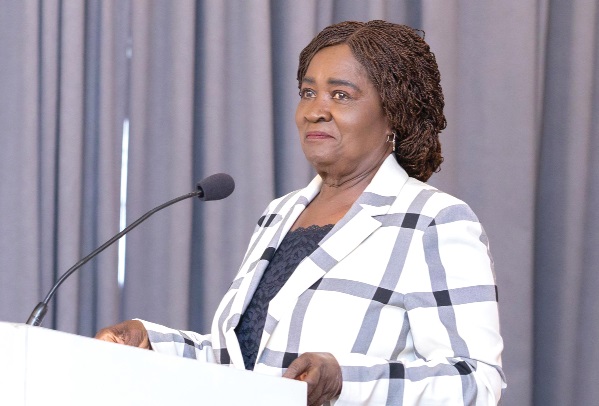
Homegrown solutions drive economic gains- Vice-President
The country is entering a new phase of economic transformation with cautious optimism and resolve, underpinned by reforms that are nationally owned and supported, rather than dictated by development partners, the Vice-President, Professor Naana Jane Opoku-Agyemang, has asserted.
She said the economic gains in the past year were being sustained by the country’s willingness to take difficult but necessary policy decisions.
Speaking during an engagement with Regional Heads of the International Monetary Fund (IMF) at a luncheon meeting in Accra last Monday, Prof. Opoku-Agyemang said Ghana’s economic reality today differed markedly from that of the recent past, citing key improvements such as a single-digit inflation, a more stable local currency and a stronger real Gross Domestic Product (GDP) growth.
She emphasised that the gains were tangible and were being felt across the economy, rather than remaining abstract macroeconomic indicators.
The Vice-President acknowledged the support of the IMF for the economic turnaround, saying “IMF programmes are neither painless nor perfect, but when economies are under stress, pragmatism, credibility and discipline matter more than rhetoric.”
Context
Attended by IMF Africa regional officials and staff of the Ghana Country Office, other development partners and the diplomatic corps, Prof. Opoku-Agyemang used the platform to reflect on Ghana’s economic experience amid heightened global concerns over debt and development finance.
The meeting provided the Vice-President and senior economic advisers of the government with the opportunity to outline Ghana’s improving macroeconomic conditions and to situate the country’s recovery within broader continental and global economic shifts.
Ghana is under a $3 billion Extended Credit Facility (ECF) agreement with the IMF, which is geared towards lowering the country’s unsustainable debt levels and bringing reforms that would ensure growth with jobs.
The Executive Board of the IMF last month approved the fifth review of the facility (ECF) arrangement with Ghana, unlocking the immediate disbursement of about $385 million, bringing total disbursements under the arrangement to about $2.8 billion.
Ghana’s 39-month ECF arrangement, the 18th for the country, started in May 2023 after debt to Gross Domestic Product (GDP) worsened to 85.7 per cent in 2022.
After two and half years of implementation, the IMF in its fifth review confirmed that Ghana’s supported reforms were yielding results after last year’s policy slippages.
Debt-to-GDP ratio improved to 66.75 per cent at the end of last year.
“Growth through September 2025 exceeded expectations, driven by strong services and agriculture,” it said.
Inflation has also fallen from 23.8 per cent in December 2024 to 5.4 per cent in December 2025.
Relevance
Prof. Opoku-Agyemang said Ghana’s recovery demonstrated “what is possible when strong national commitment meets coordinated multinational support. It is not a perfect story, but it is a credible one for Africa as a whole.”
She acknowledged the continued relevance of international financial institutions on African countries, while observing that recent global and regional developments increasingly demonstrated Africa’s readiness to do more on her own.
The Vice-President stressed that the growing self-confidence of African countries did not diminish the value of partnerships, but rather underscored the need for cooperation that was mutually beneficial and responsive to Africa’s development priorities.
“Like every other region, Africa faces economic challenges.
Some are domestic, some are structural, and others arise from unequal trade terms and shifting global economic conditions.
These are not excuses; they are realities that must be confronted honestly,” she stressed.
She reaffirmed the position of President John Dramani Mahama that Ghana’s relationship with the IMF must evolve beyond emergency support arrangements.
Prof. Opoku-Agyemang stressed that while Africa continued to grapple with structural challenges such as high borrowing costs, the continent also possessed significant opportunities, including the transformative potential of the African Continental Free Trade Area (AfCFTA) to deepen intra-African trade.
The Vice-President said the country remained committed to pursuing self-reliance, supported by coordinated, fair and development-oriented international cooperation.
