Include more women in decision-making — Panellists
Panellists at a national youth conference have highlighted the need to have more women in the decision-making process at all levels of society since women form the majority of the country’s population.
They explained that since women made up 51 per cent of the country’s population and provide the majority of its labour, it was only logical to involve them more in decision-making.
Moreover, the panellists noted that involving women in leadership and decision-making at all levels of society leads to better outcomes.
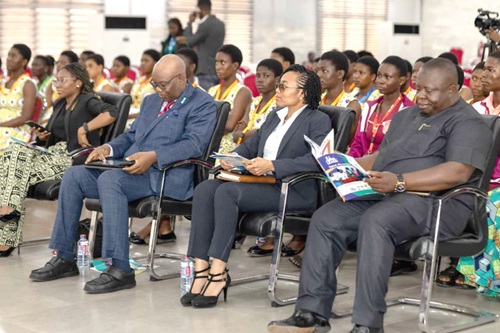
The panellists were speaking at the breakout session on “Girls and young women’s participation in political leadership” at the ongoing National Youth Conference taking place at Gomoa Fetteh in the Central Region.
Plan International Ghana’s groundbreaking initiative, She Leads Project, partnered the National Youth Authority (NYA), organisers of the conference, for the session, which aimed at amplifying the voices of young women and girls in leadership and governance.
Through the platform, they hope to build the capacity of young women to actively participate in political leadership and to shape policies that will directly impact their lives and communities.
The panellists include a Deputy Presidential Spokesperson, Shamima Muslim; Musah Abdulai of the Office of the Vice-President; the Coordinator of Affirmative Action Law Coalition, Becky Ahadzi, and a former Students Representative Council President of the SD Dombo University, Priscilla Khadijah Vawurah.
Population
Among other things, Mr Abdulai said: “Men are 49 per cent of the country’s population, so it stands to reason that women should take up leadership positions because in democracy, the majority is always right and it is based on majority decisions that we use in governing the country”.
He said it was rather unfortunate that in Ghana and Africa, girls and women were usually unable to represent or actively participate in politics due to a number of reasons.
He mentioned those reasons to include the fact that most women did not have the financial muscles to fulfil their political goals, and the lack of mentorship and training.
Ms Muslim, for her part, said including more women in the decision-making process of the country was the most practical thing to do since they were the most productive force, even though they were mostly found in the informal economy.
“Women provide the majority of labour. So it is practical, ethical, and it makes business and political sense actually to involve and include women in decision making,” she added.
She urged the gathering, which was largely students from second-cycle institutions, to break generational cycles by identifying leaders who could inspire them to take up leadership positions.
Touching on the 30 per cent quota in the Affirmative Action Law, Ms Ahadzi urged the youth to familiarise themselves with the law by studying it.
Courageous
Ms Vawurah urged the youth to be courageous if they were going to accept the offer to lead.
Earlier in his opening remarks, the Country Director of Plan International Ghana, Constant Tchona, said the occasion was an opportunity to confront head-on the systematic barriers that young women faced in politics and leadership and also to examine how they could, as a collective, dismantle those barriers to create an environment that truly valued and amplified their contributions.
“We will explore the importance of ensuring that girls and young women have the agency, the platform, and the resources to participate fully in political processes.
“We will discuss how we can foster environments where their voices are not just heard but are also acted upon.
We will reflect on how to build a Ghana where leadership is not determined by gender, but by merit, vision and commitment to the public good,” he said.
The Member of Parliament (MP) for Klottey Korle Constituency, Dr Zanetor Agyeman-Rawlings, said countries where women were in leadership positions developed faster and their security was intact.