
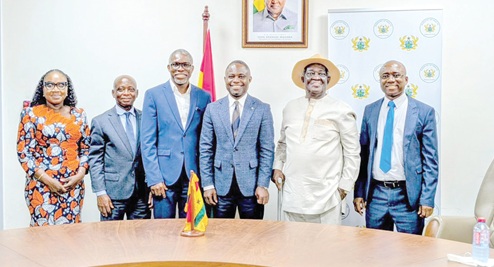
Inter-Ministerial C’ttee on Decentralisation, Health Ministry confer on devolution agenda
The Inter-Ministerial Coordinating Committee (IMCC) on Decentralisation has initiated discussions with the Ministry of Health to revive the country’s long-standing health sector devolution agenda.
The discussion formed part of renewed efforts under the National Decentralisation Policy and Strategy (2026-2030) to harmonise laws and devolve key sectors, including health, to improve service delivery in metropolitan, municipal and district assemblies (MMDAs).
It also reflects a key commitment under the government’s “Resetting Ghana” agenda, as outlined in its manifesto and championed by President John Dramani Mahama.
Consultations
At the engagement last Tuesday, the Executive Secretary of the Inter-Ministerial Coordinating Committee on Decentralisation, Dr Gameli Kewuribe Hoedoafia, recalled that between 2015 and 2016, extensive consultations were held to devolve health services.
Unfortunately, the process could not be completed before the end of President John Mahama’s administration.
He stressed that health and education remained the most critical services affecting citizens at the local level, and, therefore, the decision-making authority should be placed closer to the people.
Dr Hoedoafia further highlighted that local governments already committed substantial resources to health and education, especially through CHPS compounds and community-level interventions, making a strong case for granting them greater control over service delivery and decision-making.
Obligation
Referencing Article 35(6d) of the 1992 Constitution, he underscored the national obligation to decentralise administrative and financial authority to districts and regions to drive local development.
He noted that the country had already established a strong legal basis for decentralisation through the Local Governance Act, 2016 (Act 936).
However, he pointed out that key sector-specific laws, particularly the law governing health, must be reviewed to align with devolution.
This includes amending existing legislation to empower local structures to function effectively once responsibilities are transferred.
To advance that agenda, he revealed that a Legislative Review Committee has been established, chaired by the Chairman of the IMCC Legislative Review Committee, Prof. Kwamena Ahwoi, to oversee reforms across sectors, with the health sector now a top priority.
Initiative
In his response, the Minister of Health, Kwabena Mintah Akandoh, welcomed the initiative and reaffirmed his commitment to supporting the President’s decentralisation agenda.
He said the ministry had already begun implementing elements of decentralisation, particularly in the recruitment of health professionals.
“We are moving recruitment to the district level,” he explained.
The minister described the IMCC’s proposal as “a fantastic concept” and pledged the ministry’s full participation in achieving the broader vision of decentralised governance, especially in primary healthcare provision.
