
NAIMOS intensifies swoops in galamsey fight
Despite sustained efforts by the National Anti-Illegal Mining Operations Secretariat (NAIMOS) to crack down on illegal mining activities, recalcitrant miners continue to wreak havoc on the country's land, forest, and water resources with impunity.
Since the secretariat was set up in July this year, it has conducted many intelligence-led operations across mining communities in the country, leading to the destruction of illegal mining enclaves and disruption of networks perpetrating the act.
As of November 30, 1,486 illegal miners had been arrested by the NAIMOS team, who also confiscated 443 excavators and other mining equipment.
However, pervasive illegal mining in the belly of water bodies and designated buffers has left the country’s major rivers, such as the Pra, Ankobra, Bia, Offin, Ayensu, and Birim, heavily polluted.
Forest reserves, which provide essential ecological services, are also being pillaged with impunity by the illegal miners, even as NAIMOS works on its mandate to clamp down on the menace.
Recent onslaught
In the latest intelligence-led operations by the NAIMOS taskforce in the Western, Western-North, and Eastern regions between Thursday, December 4 and Saturday, December 6, it was discovered that in their unorthodox means of searching for gold, the illegal miners had blocked the Bia and Ayensu rivers that serve as a source of water for residents in those regions.
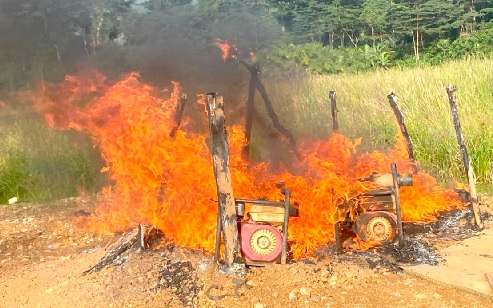
Some makeshift structures at galamsey sites set ablaze by NAIMOS task force
NAIMOS also discovered that the Atewa Forest, which is noted for its rich ecological wealth and a globally significant biodiversity area (GSBA), is under siege by illegal miners on a scale never imagined.
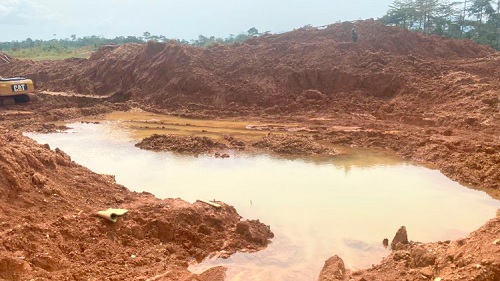
The illegal miners have expanded their operations deep into the forest reserve, leaving behind numerous uncovered pits filled with water.
Also, vast tracts of farmland continue to be stripped bare as illegal miners carve them into deep pits filled with murky water used for washing gold.
There was also worrying evidence of child labour in the illegal mining sites, particularly in the Eastern Region, where the NAIMOS team rescued many children working with adult illegal miners who had escaped arrest.
Western enclave clampdown
A 30-member team of NAIMOS officers undertook swoops at notorious illegal mining enclaves at Dadieso in the Suaman District in the Western-North District on December 6, and arrested nine Chinese illegal miners after many others had escaped.
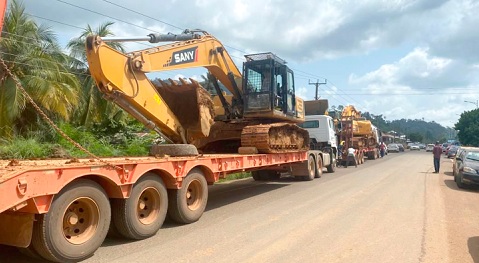
Seized excavators being conveyed by NAIMOS for safe keeping
The NAIMOS team destroyed Changfang machines, heavy-duty pumping machines and make-shift structures that the illegal miners used for their operations.
The task force also entered the Kwabena Lantey and Suibo operational zones and uncovered a huge illegal mining concession hidden within dense vegetation close to the Bia River.
Operators of the illegal site escaped upon a tip-off and concealed some excavators in the bush in an attempt to prevent their seizure.
Through intensified intelligence-led operations at a suburb of Dadieso known locally as Niger, the NAIMOS team recovered a mobile phone with communications linked to a contact on a WhatsApp platform.
The messages on the WhatsApp platform pointed to direct coordination by foreign nationals in the galamsey operations.
Acting on that critical lead, the NAIMOS operatives tracked and apprehended nine Asian men and escorted them to multiple sites to corroborate their involvement in the galamsey activities on the ground.
Anonymous caller
Meanwhile, NAIMOS officers disclosed that an anonymous caller attempted to bribe the team with GH¢2.7 million in exchange for the release of the detained foreign nationals.
The offer was reportedly "immediately rejected," although the Daily Graphic could not confirm the identity of the alleged caller.
The Director of Operations of NAIMOS, Col. Dominic Buah, stressed that he was in control of strategic swoops and would ensure that the officers on the field acted within their mandate and adhered to national security priorities.
Eastern Region operations
Similarly, NAIMOS carried out a two-day operation in the Atewa area and the Fanteakwa District in the Eastern Region during which it disrupted the activities of illegal miners and destroyed many heavy-duty machines.
The task force stormed the Bunso and Nsutem enclaves, where there were noticeable scars of uncontrolled mining.
Across both sites, the illegal miners abandoned their work and disappeared into the bush upon seeing the NAIMOS team, leaving behind their mining equipment.
Atewa Forest
The NAIMOS team shifted focus to the Atewa Forest in pursuit of persistent illegal mining networks.
The team was greeted with the stark reality of the large-scale destruction of the reserve.
For instance, at Pimpong, deep pits left behind by illegal miners spanned several hectares of land.
It was observed that the galamsey operators had cut channels to divert the Ayensu River at Fante Ebuorho directly onto their site.
Here, minors between 13 and 15 years were found working in the pits, handling tools and assisting adults who fled into the bush at the approach of the security team.
The NAIMOS officers secured the children and removed them from the area before continuing their work.
Birim River enclave
The task force also swept through Akwadum, Ayigbe Town and Ankaase Osino in the Abuakwa South and Fanteakwa districts, dismantling active galamsey sites and disabling heavy machinery used in the destruction of forest reserves and vital water sources.
At Akwadum, the team seized five excavators used to destroy the Birim River. At Ayigbe Town, NAIMOS officers encountered another active illegal operation and seized two more excavators.
No retreat
The Director of Communications at the Ministry of Lands and Natural Resources, Mawusi Ama Mawuenyefia, told the Daily Graphic in an interview that the latest swoops by NAIMOS were a demonstration that the task force was at the forefront of the fight against illegal mining.
"Their continued presence is reshaping the calculations of galamsey operators, discouraging entrenched networks and proving that swift, coordinated, and persistent enforcement can reverse the damage done across affected regions," she said.
